




Imagine two startups standing at the same crossroads.
One wants to raise money by issuing digital tokens on a blockchain. The other wants to raise capital by selling shares to the public and becoming a listed company.
Both may raise funds. Both can attract investors. Both create opportunities and risks. But an Initial Coin Offering (ICO) and an Initial Public Offering (IPO) are fundamentally different fundraising mechanisms.
An ICO generally involves offering digital tokens or crypto assets. An IPO involves an unlisted company offering shares or other eligible securities to the public, typically as part of becoming publicly traded.
The differences go far deeper than “crypto versus stocks.” They affect ownership, investor rights, regulation, disclosures, liquidity, taxation, compliance, and risk.
Quick Summary
An IPO raises capital by offering securities such as shares and can lead to stock-exchange listing. An ICO raises capital through the issuance and sale of digital tokens. A token offering can still fall under securities laws depending on the rights attached to the token and the applicable jurisdiction.
Key Takeaway
- IPO = public securities + company ownership + established securities-market framework.
- ICO = digital tokens + blockchain infrastructure + rights determined by token design and applicable law.
- Neither structure guarantees success. The winning approach is choosing the model that aligns with the business, technology, economics, investors, and regulatory reality.
Table of Contents
- ICO vs IPO: At a Glance
- What Is an ICO?
- What Is an IPO?
- The Biggest Difference: What the Investor Gets
- How Fundraising Works
- Why Startups Consider ICOs
- Why Startups Choose an IPO
- Risk Comparison for Investors
- Regulatory Differences
- ICO vs IPO in India
- Cost and Compliance
- Liquidity vs Ownership
- Security Token Offerings (STOs)
- Which Is Better for a Startup?
- Founder’s Decision Checklist
- Investor’s Due-Diligence Checklist
- Frequently Asked Questions
- Key Takeaway
ICO vs IPO: At a Glance
| Factor | ICO | IPO |
|---|---|---|
| Full form | Initial Coin Offering | Initial Public Offering |
| What is offered? | Digital tokens / crypto assets | Shares or other eligible securities |
| Investor receives | Token-related rights (utility, governance, etc.) | Ownership and economic rights in securities |
| Blockchain involved? | Usually | Not inherently |
| Stock exchange listing | Not necessarily | Generally associated with listing |
| Primary regulator | Depends on jurisdiction and token nature | Securities-market regulator (e.g., SEBI, SEC) |
| Investor ownership | Not automatically equity ownership | Shareholders receive ownership interest |
| Disclosure framework | Depends on jurisdiction and classification | Formal prospectus / offer-document requirements |
| Liquidity | Depends on token and trading venues | Listed shares trade on recognised exchanges |
| Typical stage | Often early-stage blockchain/Web3 projects | Usually more mature companies |
| Regulatory certainty | Highly dependent on structure & jurisdiction | Established securities framework |
| Main investor risks | Token, technology, regulatory, liquidity, project risk | Business, valuation, market, governance risk |
Note: Exact legal treatment depends on jurisdiction, token/security structure, and applicable regulations.
What Is an ICO?
An Initial Coin Offering is a fundraising method in which a blockchain project offers digital tokens to participants.
Tokens may provide access to a platform, utility within an ecosystem, governance rights, or, in some cases, investment characteristics.
Buying a token does not automatically mean buying ownership in the company. The rights depend entirely on the token’s design and legal structure.
The U.S. Securities and Exchange Commission has consistently stated that whether a crypto asset is a security depends on the facts and circumstances. A crypto asset may become subject to federal securities laws when offered and sold as part of an investment contract.
Changing the format from a paper certificate to a blockchain token does not automatically remove securities-law obligations.
What Is an IPO?
An Initial Public Offering is the process through which an unlisted company offers shares or eligible securities to the public for the first time.
In India, SEBI explains that an IPO may involve a fresh issue of shares or convertible securities, an offer for sale by existing shareholders, or both. The process typically leads to listing and trading on stock exchanges.
- Fresh issue: Company issues new securities → investors provide capital → company receives funds.
- Offer for sale: Existing shareholders sell their securities → proceeds generally go to the selling shareholders.
An IPO is therefore not always equivalent to “the company receives all the money raised.”
Also Read
The Biggest Difference: What the Investor Gets
This is the most important distinction.
In an IPO
Investors purchase shares or other eligible securities and typically receive:
- Ownership interest
- Voting rights (depending on share class)
- Potential dividends
- Potential capital appreciation
- Rights under corporate and securities laws
In an ICO
Investors receive a digital token. The token may offer utility, governance, or other benefits depending on its design. It does not automatically represent equity ownership in the issuing company.
Token ≠ Share. These are not interchangeable concepts.
How Fundraising Works
How an IPO Works
A typical IPO involves extensive preparation: corporate restructuring, appointment of intermediaries, due diligence, preparation and filing of offer documents, regulatory review, pricing, public subscription, allotment, and listing.
In India, the framework is governed by SEBI’s Issue of Capital and Disclosure Requirements (ICDR) Regulations, 2018 (last amended on 21 March 2026), along with the Companies Act, 2013 and stock-exchange requirements.
How an ICO Works
An ICO can be technologically simpler: design the token, deploy blockchain infrastructure, publish documentation, set tokenomics, market the offering, accept contributions, and distribute tokens.
Technological simplicity should never be confused with regulatory simplicity. If the token constitutes a security or investment contract, applicable securities laws apply.
Why Startups Consider ICOs
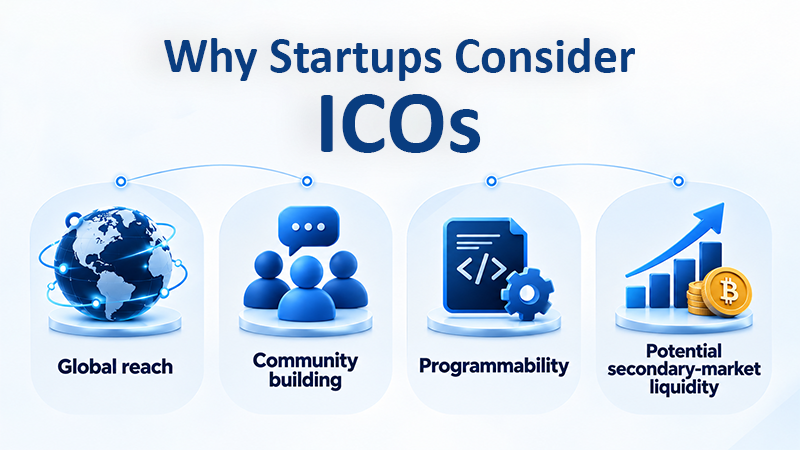
- Global reach – but this creates multi-jurisdiction compliance challenges.
- Community building – tokens can create economic alignment with users.
- Programmability – tokens can be embedded in smart contracts and applications.
- Potential secondary-market liquidity is never guaranteed.
Why Startups Choose an IPO
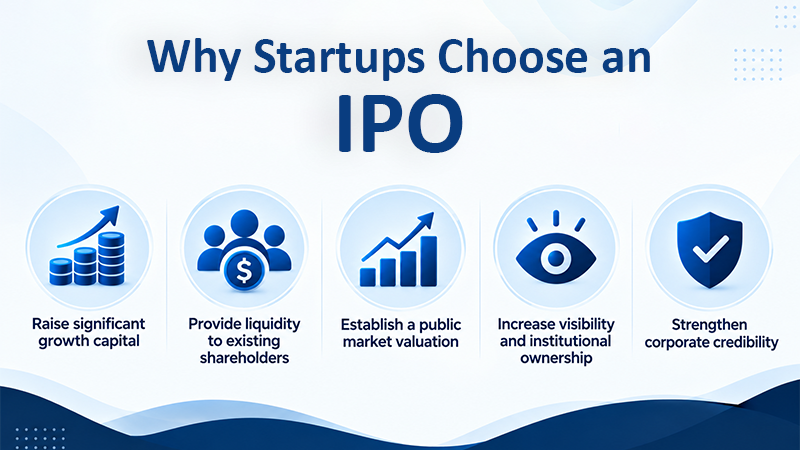
Companies typically pursue an IPO when they have reached commercial maturity and want to:
- Raise significant growth capital
- Provide liquidity to existing shareholders
- Establish a public market valuation
- Increase visibility and institutional ownership
- Strengthen corporate credibility
An IPO places the company under continuous public-market disclosure and governance obligations.
Risk Comparison for Investors
Neither structure is risk-free.
IPO risks include business performance, market volatility, valuation, competition, governance, and broader economic factors.
ICO risks include all of the above in project form, plus:
- Smart-contract vulnerabilities
- Wallet and custody risks
- Token liquidity and tokenomics risk
- Blockchain infrastructure risk
- Regulatory classification risk
- Cybersecurity and project-abandonment risk
Sophisticated technology does not automatically make a sophisticated investment.
Regulatory Differences
IPO regulation operates within an established securities-market framework (SEBI in India, SEC in the U.S., etc.) with clear rules on disclosure, due diligence, governance, and intermediary responsibilities.
ICO regulation has no single global regulator. Treatment depends on the country, token characteristics, investor rights, marketing, and whether the offering constitutes an investment contract or other regulated instrument. An ICO is not automatically “unregulated.”
An IPO is not automatically “risk-free.”
ICO vs IPO in India
India has a clear regulatory framework for public offerings through SEBI.
Virtual Digital Assets (VDAs) are subject to a specific tax regime. Income from the transfer of VDAs is taxed at 30% under Section 115BBH of the Income-tax Act, 1961 (plus applicable surcharge and cess). From 1 April 2026, these provisions are administered under the Income Tax Act, 2025 framework. TDS provisions also apply on specified transfers.
Taxation does not equal regulatory approval for token offerings. Founders considering any token-based fundraising in or from India must obtain proper legal, tax, AML, and securities-law advice covering both Indian and foreign jurisdictions.
Cost and Compliance
IPO costs are typically high and include investment bankers, legal advisers, auditors, due diligence, regulatory filings, exchange listing fees, and ongoing compliance obligations.
ICO costs may appear lower because blockchain can automate issuance. In practice, a serious offering still requires smart-contract audits, cybersecurity, tokenomics design, legal opinions, tax analysis, AML/KYC processes, and cross-border compliance. A single smart-contract flaw can destroy value that no marketing budget can restore.
Liquidity vs Ownership
A token may be transferable or tradeable, but that does not automatically grant equity ownership, voting rights, dividends, or claims on company assets.
Listed IPO shares offer exchange liquidity, yet their market price can still fall substantially. Transferability and economic ownership are distinct concepts.
Security Token Offerings (STOs)
Security Token Offerings sit between traditional ICOs and IPOs. In an STO, the token itself is designed as a security (representing equity, debt, or other financial rights) and is issued under applicable securities laws. STOs generally involve higher compliance than utility-token ICOs but can offer clearer investor rights than pure utility tokens.
Which Is Better for a Startup?
There is no universal answer.
An ICO (or token offering) may suit projects that are fundamentally blockchain-native, where the token has genuine utility, and where legal structure has been carefully evaluated.
An IPO is generally more appropriate for mature companies seeking institutional capital, public-market liquidity, and traditional equity ownership.
For many early-stage startups, the realistic alternatives are still venture capital, private equity, strategic investment, or convertible instruments rather than a full public IPO.
Founder’s Decision Checklist
Before launching a token offering, ask:
- Does the token serve a genuine purpose in the product or ecosystem?
- Could it be classified as a security or investment contract in target jurisdictions?
- What exact rights does the buyer receive?
- Are tokenomics, vesting, and dilution transparent and sustainable?
- Has the smart contract been independently audited?
- Who controls upgrades, treasury, and governance?
- Is there realistic demand and liquidity beyond speculation?
- What AML/KYC, tax, securities, and consumer-protection rules apply?
- Where are potential investors located?
Investor’s Due-Diligence Checklist
For an IPO – carefully review the Red Herring Prospectus / Prospectus, financials, risk factors, use of proceeds, promoter background, valuation, and existing shareholder selling.
For an ICO / token offering – examine the whitepaper, token utility and allocation, vesting schedules, team credentials, smart-contract audit reports, treasury and governance model, legal classification, jurisdictions, product progress, and token supply dynamics.
Most important question: What creates sustainable demand for this token if pure speculation is removed?
Frequently Asked Questions
Is an ICO the same as an IPO?
No. An ICO involves digital tokens; an IPO involves shares or other securities. Rights and regulatory frameworks differ fundamentally.
Which is better?
Neither is universally better. Choice depends on business model, maturity, regulatory environment, and strategic goals.
Is an ICO regulated?
It depends on the token structure and jurisdiction. Securities laws may apply if the offering meets the relevant legal tests.
Does an ICO give company ownership?
Not automatically. Token rights are defined by the token’s design and applicable law.
Is an IPO safer?
“Safer” is relative. IPOs operate under established frameworks, but shares can still lose significant value. ICOs add technology, liquidity, and classification risks.
Can a startup do both?
Potentially, but it creates substantial legal, structural, and disclosure complexity.
Can Indian startups launch an ICO?
It requires case-by-case legal, tax, AML, and securities analysis under Indian and foreign laws. Professional advice is essential.
How is an ICO taxed in India?
Gains from Virtual Digital Assets are taxed at 30% under Section 115BBH (plus surcharge and cess), with the framework continuing under the Income Tax Act, 2025 from 1 April 2026.
What is the difference between ICO, IEO, and IDO?
An ICO is typically a direct project offering. An IEO is facilitated by a crypto exchange. An IDO is conducted through a decentralised exchange or similar mechanism. Compliance treatment varies by jurisdiction.
About Coin Developer India
Coin Developer India is an ICO development company in India that helps businesses and entrepreneurs build blockchain-based fundraising solutions, including token development, cryptocurrency development, and blockchain platforms.
If you have weighed an ICO against an IPO and decided the token route fits your project, the technical foundation is where that decision either holds up or falls apart. Our team handles the engineering side of a launch: ERC-20 and multi-chain token contracts, ICO and IDO sale contracts, tokenomics modelling, vesting and treasury logic, and pre-audit preparation. Founders across India and overseas work with us at different stages, some from the whitepaper onward, others to review a contract that was already written. Either way, the goal is the same: a codebase your legal counsel can assess with confidence rather than a retrofit built after the fact. Technical development for any token launch should always be paired with appropriate legal, tax, regulatory, cybersecurity, and compliance advice for the jurisdictions in which the project intends to operate. Planning a token sale? Talk to our team for a free initial consultation.
Disclaimer: This article is for educational and informational purposes only and should not be treated as legal, tax, financial, or investment advice. Cryptocurrency and token regulations change rapidly and vary between jurisdictions. Businesses and individuals should obtain advice from qualified professionals before conducting an ICO, token sale, STO, or IPO.