




In today’s digital revolution, social media plays a vital role in everyone’s daily life. It helps us connect with our family and friends and simplify everyday tasks. It is evident from research that, on average, a person spends roughly 2 hours and 21 minutes daily on social media.
With that, have you ever thought about how social media is going to change with the advent of the new generation on the internet? Social networks have profited from our data for years with minimal input from users. What occurs when power returns to the people?
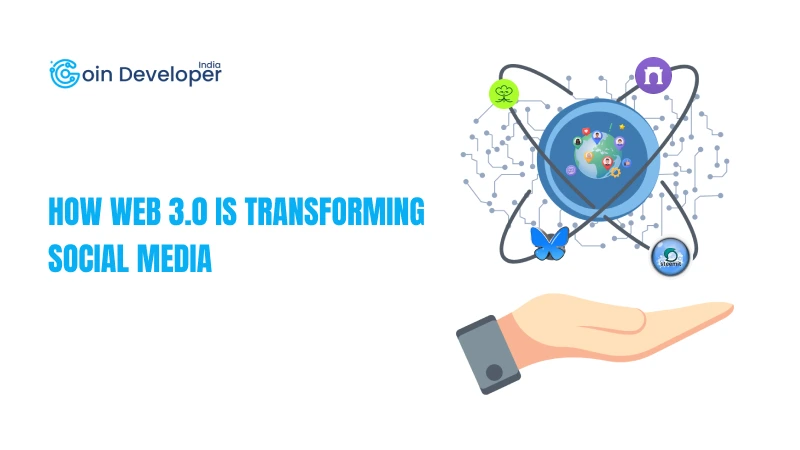
This is where Web 3.0 comes into the picture. By leveraging the power of blockchain technology, dApps, and token-based incentives, Web 3.0 is already reshaping how we create, share, and engage online. And it clearly denotes how Web 3.0 is different from Web 2.0.
In this blog, we will provide valuable insights into the revolutionary landscape of social media in Web 3.0, discuss how it is transforming our interactions, and present current real-world examples of its usage.
What Makes Web 3.0 Social Media Different?
Web 3.0 social media isn’t just about slapping on some new features to the social networks we already use. It’s really a significant change in how we view and interact with social media in general. Web 3.0 social media is based on blockchain technology, and it provides:
Decentralization
Decentralization means that no single firm or organization controls it; it is controlled by the network of people who use it.
Ownership
Users hold true control over their data, digital identity, and content, rather than a centralized platform owning them.
Transparency
Every action on Web 3.0 social media is recorded and stored in a public ledger. This makes censorship and manipulation a lot harder for anyone.
In short, Web 3.0 social media puts the power back in your hands. This new iteration of social media gives users more control over their data, content, and interactions, unlike traditional social media’s centralized control.
How Is Web 3.0 Transforming Social Media?
Web 3.0 development services are changing how we interact with social media. Let’s see some noticeable ways that Web 3.0 is transforming social media:
Enhanced Privacy and Data Ownership
Web 3.0 applications prioritize giving control to the users over their personal information. These applications offer a more secure and private user experience by leveraging blockchain and cryptographic protocols. Users fully own and manage their data, lowering the chances of data breaches and unauthorized access.
Decentralized Identity (DID) Systems
In Web 3.0, Decentralized Identity (DID) systems revolutionize online authentication by replacing conventional username and password logins with a more secure and privacy-centric model. They allow users to prove their identities without revealing personal information, significantly reducing the risk of identity theft and phishing attacks.
Data Encryption
Web 3.0 applications deploy robust encryption algorithms that protect users’ data during transmission and storage. This ensures that even in the event of an attack, the hacker cannot read or use the extracted data.
Transparent and Auditable Transactions
All the transactions that occur on the blockchain are recorded on a public ledger. This ensures transparency and accountability with each transaction on its immutable ledger. This approach makes it difficult for any bad actor to manipulate the data or conceal their malicious activities.
Reduced Reliance on Third-Parties
In Web 3.0, users can interact directly with services and applications without relying on any intermediaries. We can minimize the risk of data leakage or compromise by sharing sensitive personal information across multiple third parties.
Community Governance
Decentralized governance within social platforms empowers users to engage in the decision-making process, building a sense of community pride and getting people involved. It tackles issues related to transparency, accountability, and responsiveness.
Voting in Decision-Making
In Web 3.0, users can vote on proposed changes in the platform’s policies, rules, and various governance methods and features. This ensures smooth and democratic decision-making, reflecting the community’s collective voice.
Delegated Decision-Making
Users can assign decision-making power to trusted individuals or organizations that align with their values and interests. This makes for more efficient and specialized decision-making while maintaining involvement in the community.
Open Governance
The entire community can transparently access all decisions and discussions related to the platform’s governance. This fosters trust and accountability among the users, as they can see when decisions are made and by whom.
Monetization Opportunities
Blockchain technology enables the creation and exchange of digital tokens representing exclusive content, special benefits, or rewards through NFTs. This transparency and security build trust, authenticity, and community loyalty.
Real-World Examples of Web 3.0 Social Media
Here are some of the leading and most popular Web 3.0 social media platforms available today:
Minds
Minds is an open-source Web 3.0 social media network that rewards users with cryptocurrency for their participation. You can earn Minds tokens just by posting, sharing, and inviting your friends. These tokens are stored on the Ethereum blockchain, which provides them with transparency and accountability for token transactions.
Audius
Built for musicians and music lovers, Audius is a decentralized, Web 3.0 music streaming platform. It lets artists share their work and earn directly from their fans. Its music streaming protocol is designed to give artists more control and revenue from their work, bypassing traditional industry intermediaries and sharks.
Diamond App
Like traditional social media channels, Diamond App has a social feed where you can see popular posts and those by the creators you have explicitly followed. Diamond App has introduced creator coins, unique tokens for each user on the social network. Users can buy, sell, and hold creator coins, including their own, allowing them to invest in creators they support.
Peepeth
Peepeth is a microblogging platform built on the Ethereum blockchain, which ensures that all user posts are saved permanently and cannot be deleted or censored. Peepeth is for users who want to express themselves freely and keep ownership of their content. Its focus on ethics and community engagement sets it apart from traditional social media.
Lens Protocol
Lens Protocol significantly transforms social media in the Web 3.0 era. Here, the blockchain securely stores all your followers and posts, eliminating the need for a central server. Thanks to the blockchain, you can keep control of your social identity and all the content you create.
Bluesky
Bluesky is a decentralized social media app founded by former Twitter CEO Jack Dorsey. It is a public conversation platform that operates on the open-source AT Protocol. It works similarly to X, allowing users to post text, images, and videos. While not blockchain-based, it aligns closely with Web 3.0 principles of openness, transparency, and user control.
Sola
Sola is a decentralized social network that allows users to share content and earn rewards based on engagement. The platform uses artificial intelligence to help users find engaging content. With its focus on user interaction and rewards, Sola reflects the growing trend of decentralized social media.
Steemit
Steemit is a social media platform that rewards users with cryptocurrency for creating and sharing content. It operates on the Steem blockchain, and users can earn tokens by getting upvotes on their posts. Steemit is ideal for bloggers and content creators who want to profit from their contributions.
Farcaster
Farcaster is an open-source and blockchain-based protocol for building decentralized social media applications. It functions similarly to HTTP, which is used for the web, allowing users to own their data instead of a single company. It provides the technical foundation for apps to interact, ensuring user control and resistance to censorship.
Chingari
Chingari blends Web 2.0 video sharing with Web 3.0 incentives through its GARI token to incentivize creators and users for their contributions. It is a video-sharing social media platform created in India and launched in 2018. It is available in more than 20 languages and has a worldwide community of over 175 million people. Chingari leverages the GARI token.
In addition to that, you can check other top 10 use cases of Web 3.0 technology in this blog:
Conclusion
In conclusion, Web 3.0 is here to transform the social media landscape by offering features like decentralization, tokenomics, smart contracts, and open governance. It improves all the limitations that we have with traditional social media and works on providing innovative solutions.
As we have seen, Web 3.0 social media is closer than you think, with applications and platforms like Bluesky, Lens Protocol, Steemit, Audius, Farcaster, and many more. The world is moving fast, and you need to act swiftly to keep up with the ever-evolving social media space.
This is where partnering with a reputable Web 3.0 service provider can be beneficial for you. At Coin Developer India, we provide our customers with best-in-class Web 3.0 social media solutions.
Contact us today!