




Key Takeaways
- A successful ICO rests on three pillars: sound tokenomics, audited smart contracts and clear regulatory structuring.
- Most stages run in parallel, so legal work and platform development should start early.
- Unaudited contracts and opaque vesting schedules are among the fastest ways to lose investor trust.
- Multi-signature treasuries and time-locked team allocations are now baseline expectations, not optional extras.
- Regulatory obligations follow the issuer, not the sale venue. Running a sale on a DEX or launchpad does not remove them.
Table of Contents
- What Is the ICO Development Process?
- What Is an ICO, and Why Does the Process Matter?
- ICO Development Process at a Glance
- Stage 1: Concept Validation and Feasibility
- Stage 2: Tokenomics Design
- Stage 3: Legal and Regulatory Structuring
- Stage 4: Smart Contract Development for Token Sales
- Stage 5: Security Audit and Remediation
- Stage 6: Sale Platform, Whitepaper and Investor Onboarding
- Stage 7: Token Sale Launch, Distribution and Listing
- ICO vs IEO vs IDO vs STO: Quick Comparison
- Cost and Timeline Factors
- Common ICO Development Mistakes to Avoid
- Frequently Asked Questions
- Build Your ICO With Confidence
What Is the ICO Development Process?
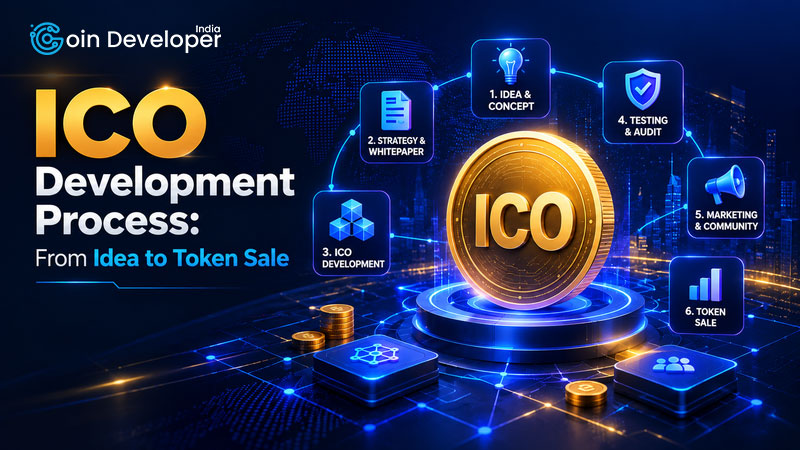
The ICO development process is the end-to-end sequence that takes a token project from concept to public sale. It consists of seven stages: (1) concept and feasibility, (2) tokenomics design, (3) legal and regulatory structuring, (4) smart contract development, (5) security auditing, (6) sale platform and investor onboarding (KYC/AML), and (7) launch, token distribution and post-sale listing. A well-executed project typically requires three to six months, depending on token logic complexity, audit queue length and legal review depth.
What Is an ICO, and Why Does the Process Matter?
An Initial Coin Offering (ICO) is a fundraising method in which a project issues blockchain-based tokens to investors, usually in exchange for cryptocurrency or fiat. Depending on design and jurisdiction, tokens can provide utility, governance rights, access or other functions.
The 2017 to 2018 boom exposed structural weaknesses: unaudited code, weak token economics and unclear legal status. The process matters today for three reasons:
- Blockchain transactions are irreversible. Once funds sit in a flawed contract, recovery is difficult or impossible.
- Investor trust is earned through verifiable transparency: published audits, clear vesting and accurate documentation.
- Regulation is enforceable. Depending on the jurisdiction, a token may be classified as a security, a utility instrument or a regulated crypto-asset.
Terminology note: IEOs (exchange-hosted), IDOs (DEX or launchpad-based) and STOs (security token offerings) share the broad stages of this process but differ in important ways, especially STOs. See the comparison table below.
ICO Development Process at a Glance
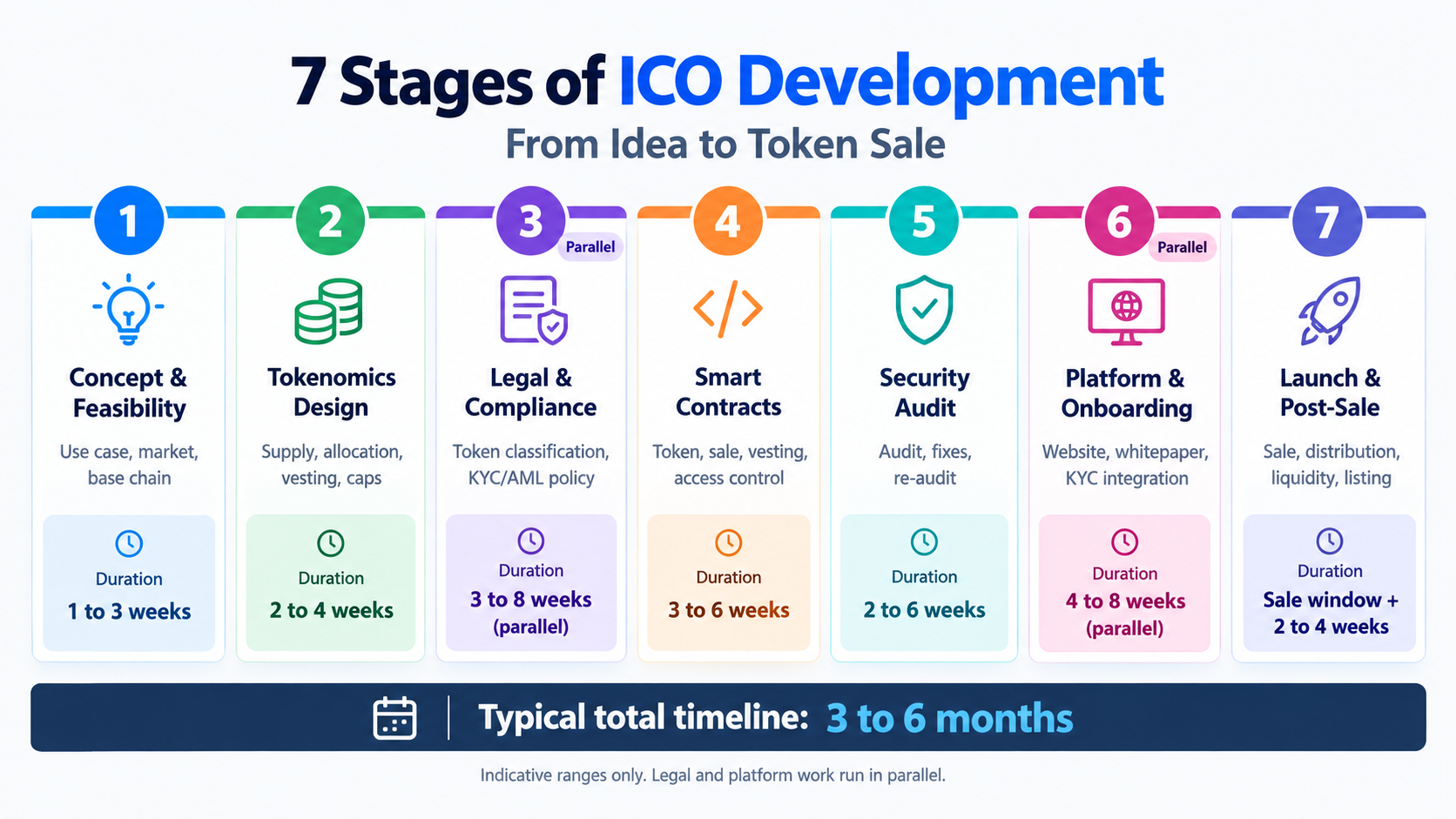
| Stage | Key Deliverables | Indicative Duration* |
|---|---|---|
| 1. Concept and feasibility | Problem statement, use case, target market, competitor analysis | 1 to 3 weeks |
| 2. Tokenomics design | Supply, allocation, vesting, pricing, caps | 2 to 4 weeks |
| 3. Legal and compliance | Jurisdiction, token classification, terms, KYC/AML policy | 3 to 8 weeks (parallel) |
| 4. Smart contract development | Token contract, sale contract, vesting, access control | 3 to 6 weeks |
| 5. Security audit | Audit report, remediation, re-audit | 2 to 6 weeks |
| 6. Platform and onboarding | Website, whitepaper, investor dashboard, KYC integration | 4 to 8 weeks (parallel) |
| 7. Launch and post-sale | Token sale, distribution or refunds, liquidity, listing | Sale window + 2 to 4 weeks |
*Indicative ranges only. Actual timelines vary with scope, team size and auditor availability.
Stage 1: Concept Validation and Feasibility
Every credible token sale begins with a clear answer to one question: why does this product need a token?
Evaluate these points before writing code:
- Problem-solution fit. Does blockchain deliver measurable value (transparency, disintermediation or programmability), or is the token decorative?
- Token utility. Define exact functions: access, payment, staking, governance or rewards.
- Market and competitor mapping. Identify comparable projects, their token models and your differentiation.
- Technical feasibility. Select the base chain (Ethereum, BNB Chain, Polygon, Solana, or a Layer-2 network such as Arbitrum, Optimism or Base) according to throughput, fees, ecosystem depth and tooling maturity. This choice also decides your development stack, since EVM chains and Solana use different languages and frameworks.
Output: a validated project brief that anchors the whitepaper and every later decision.
Stage 2: Tokenomics Design
Tokenomics is the economic architecture of the token. Weak design undermines even perfectly engineered contracts.
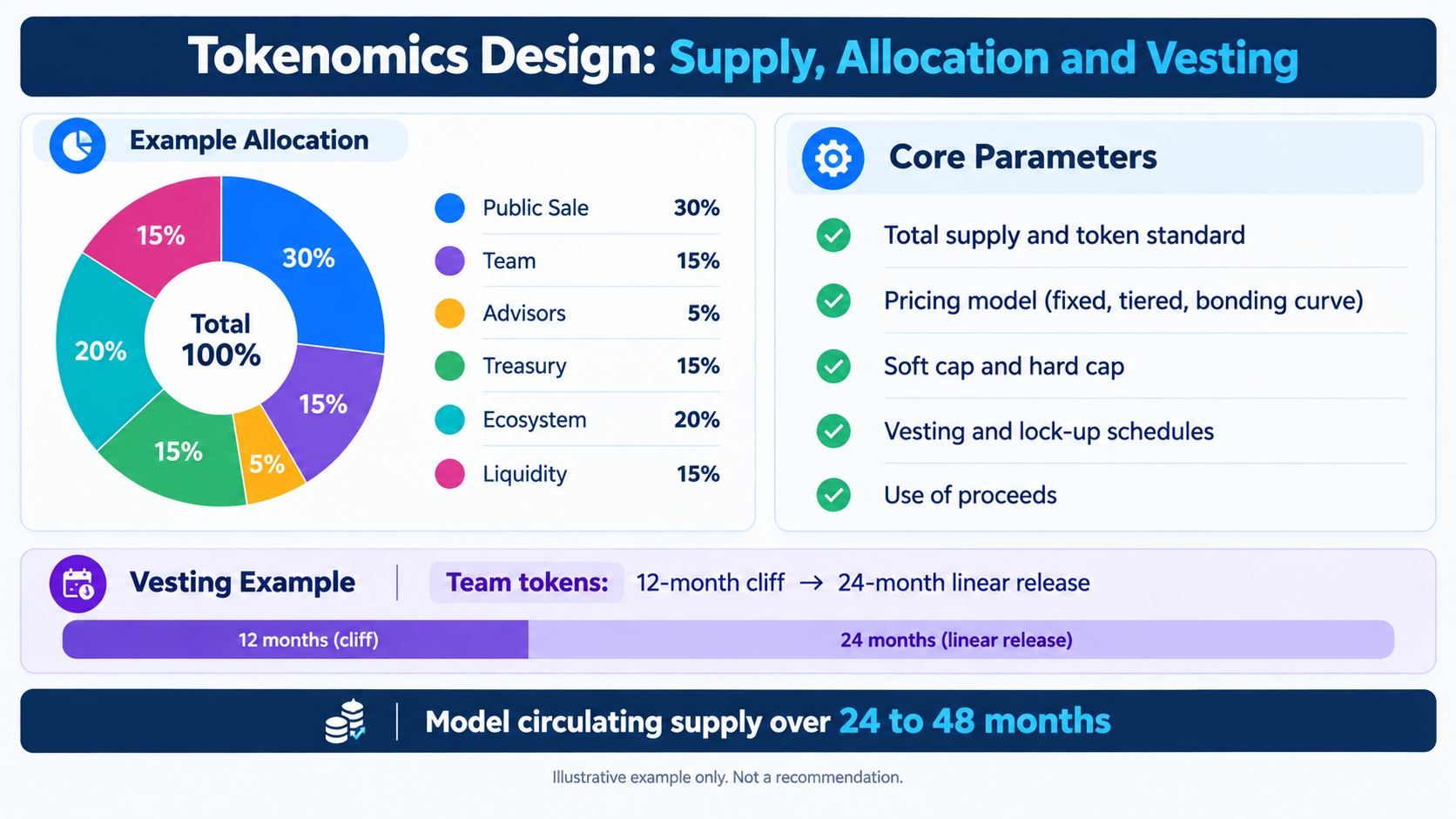
Core parameters to define:
- Total supply and token standard (ERC-20, BEP-20, SPL and so on), fixed or inflationary
- Allocation across public sale, team, advisors, treasury, ecosystem and liquidity
- Pricing model: fixed price, tiered rounds or bonding curve
- Soft cap and hard cap
- Vesting and lock-up schedules (cliffs plus linear releases for team and early investors)
- A transparent use-of-proceeds breakdown
Best practice: model circulating supply over 24 to 48 months to surface unlock cliffs and potential sell-pressure scenarios, and publish the model alongside the whitepaper so investors can verify it. For the full framework, see our ICO Tokenomics: Complete Guide.
Stage 3: Legal and Regulatory Structuring
Regulatory treatment varies sharply by jurisdiction, and non-compliance can stop a sale entirely. Address these areas with qualified counsel:
- Token classification. Is it a utility token, a security or a regulated crypto-asset? Frameworks such as the Howey test (United States) and the EU’s MiCA regulation illustrate how regimes assess the question.
- MiCA and the EU. MiCA has applied in full since 30 December 2024. For public offers of crypto-assets in the EU, it generally requires a notified crypto-asset white paper with prescribed content, subject to exemptions such as small or limited-audience offers. Asset-referenced and e-money tokens fall under separate rules.
- India. Income from the transfer of virtual digital assets (VDAs) is taxed at a flat 30% (plus applicable cess), and a 1% TDS applies to specified transfers. Since March 2023, VDA service providers must register with FIU-IND as reporting entities under the PMLA, and that coverage extends to services related to an issuer’s offer and sale of a VDA. India’s Income-tax Act, 2025 took effect on 1 April 2026 and carries the VDA regime forward, so confirm current section references and rates with a tax professional.
- Jurisdiction and entity setup. Choose the issuing entity’s location with licensing, taxation and investor eligibility in mind.
- Investor restrictions. Define excluded countries and investor categories.
- KYC/AML obligations. Establish identity verification, sanctions screening and transaction monitoring.
- Disclosures. Draft terms of sale, risk factors and a privacy policy.
Legal work must run in parallel with development and must never be treated as an afterthought.
Stage 4: Smart Contract Development for Token Sales
Smart contracts form the operational core of any ICO.
The Core Contract Stack
- Token contract: implements the chosen standard with supply, decimals and optional mint, burn or pause functions.
- Crowdsale / sale contract: manages pricing, contribution limits, caps, sale windows and refunds if the soft cap is missed.
- Vesting contract: releases locked tokens on a published schedule.
- Whitelist / access control: restricts participation to KYC-verified addresses, often via Merkle proofs for gas efficiency.
- Treasury management: routes funds exclusively to a multi-signature wallet.
Illustrative Token Contract
// SPDX-License-Identifier: MIT
pragma solidity ^0.8.20;

import "@openzeppelin/contracts/token/ERC20/ERC20.sol";

contract ExampleToken is ERC20 {
    constructor(address treasury) ERC20("Example Token", "EXT") {
        _mint(treasury, 100_000_000 * 10 ** decimals());
    }
}
This snippet is for illustration only and is not production-ready. Production contracts require additional logic, rigorous testing and a full independent audit.
Engineering Principles
- Prefer battle-tested libraries (OpenZeppelin and equivalents) over custom cryptographic or token logic.
- Apply the checks-effects-interactions pattern and protect against reentrancy.
- Minimise privileged roles and enforce least privilege.
- Put admin functions (pause, parameter changes, upgrades) behind a multi-signature wallet and a timelock, so investors can see a change before it takes effect.
- Achieve high test coverage with unit, integration and fuzz tests, and deploy to a public testnet.
- Decide early between upgradeable and non-upgradeable patterns, since each has distinct security and governance trade-offs.
- Remember that Solidity 0.8 and later reverts on arithmetic overflow by default, but
uncheckedblocks and custom arithmetic still carry overflow risk.
Token Sales on Solana
Solana projects follow a different path. Tokens are created through the SPL Token program or the newer Token-2022 program, which adds extensions such as transfer fees and transfer hooks. Sale and vesting logic is written in Rust as on-chain programs, usually with the Anchor framework, instead of Solidity and OpenZeppelin. The account model and fee structure also differ from EVM gas. Decide who holds the mint authority (and freeze authority, if enabled), disclose it to investors, and revoke it or place it under a multi-signature once supply is final. Choose auditors with Solana-specific experience.
Price Oracles for Multi-Asset Sales
A sale that accepts several assets (for example ETH, USDT and BNB) must convert each contribution into a common value. Use a decentralised price oracle such as Chainlink data feeds, add staleness and sanity checks, and avoid pricing from a single DEX spot price, which can be manipulated. Accepting only a stablecoin removes the oracle dependency but narrows who can participate.
Stage 5: Security Audit and Remediation
An independent smart contract audit is one of the strongest trust signals available to investors. A rigorous process includes:
- Manual review by experienced security engineers
- Automated static and dynamic analysis
- Severity-classified findings (critical, high, medium, low, informational)
- Full remediation and re-audit of every fix
- A published report that investors can independently verify
Common vulnerabilities to eliminate: reentrancy, access-control flaws, front-running exposure, oracle manipulation, unbounded loops, unsafe external calls and unchecked arithmetic.
Audit before launch and again after any material code change. Never deploy unaudited contracts that will hold investor funds.
Stage 6: Sale Platform, Whitepaper and Investor Onboarding
While contracts undergo audit, build the investor-facing layer in parallel.
- Whitepaper. Cover the problem, solution, architecture, tokenomics, roadmap, team, legal disclaimers and risk factors, in plain and accurate language. For offers into the EU, the MiCA white paper has prescribed content and a notification step, so plan it with counsel.
- Website and sale dashboard. Include wallet connection, live contribution tracking, countdown timers and a clear display of price, caps and rounds.
- KYC/AML integration. Connect a reputable verification provider and sync approved wallets with the on-chain whitelist.
- Community channels. Share consistent, factual updates across documentation, social platforms and developer forums.
- Multi-wallet and multi-asset support. Accept the assets your target investors actually hold, with oracle-based pricing where needed.
Stage 7: Token Sale Launch, Distribution and Listing
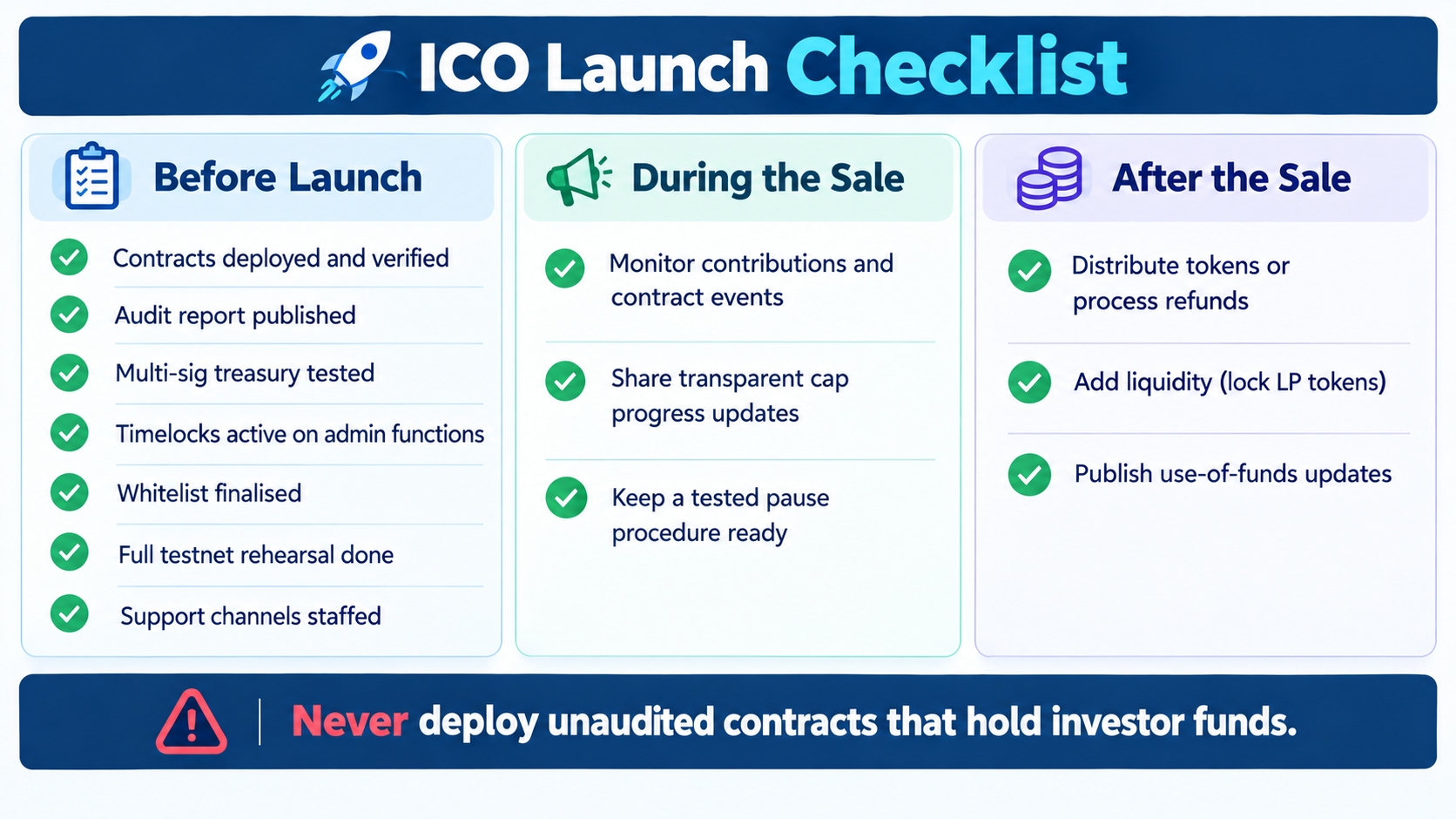
Before Launch
- Contracts deployed and verified on a block explorer
- Audit report published and linked
- Multi-signature treasury configured and tested
- Timelocks active on admin functions
- Whitelist finalised
- Full sale rehearsal on testnet: contribution, cap reached, refund, claim, vesting release and emergency pause, all using the same multi-signature setup as production
- Support and incident-response channels staffed
During the Sale
- Monitor contributions, gas conditions and contract events in real time.
- Communicate transparently about progress against the soft and hard caps.
- Maintain a tested pause or emergency procedure.
After the Sale
- Distribution or refunds. If the soft cap is met, distribute tokens according to the published schedule (immediately or through a claim contract). If it is missed, process refunds as the contract provides.
- Liquidity and listing. Provide initial liquidity on a decentralised exchange, preferably with locked LP tokens, or pursue centralised exchange listings. Listings are at the exchange’s discretion and cannot be guaranteed.
- Reporting. Publish regular use-of-funds updates and roadmap progress.
Post-sale token utility matters just as much. Tokens that remain pure fundraising instruments, with no clear product integration, tend to lose value quickly.
ICO vs IEO vs IDO vs STO: Quick Comparison
| Model | Sale Venue | Compliance Responsibility | Typical Audience | What Changes in Development |
|---|---|---|---|---|
| ICO | Project-owned platform | The issuer handles KYC, legal structuring and disclosures | Broad retail and crypto-native | Full seven-stage process |
| IEO | Centralised exchange | Exchange due diligence and listing criteria, plus the issuer’s own obligations | Exchange user base | Same core pipeline, plus exchange integration and requirements |
| IDO | DEX or launchpad | Launchpad rules vary, and the issuer’s legal obligations are unchanged | DeFi-native users | Same core pipeline, with sale mechanics adapted to the launchpad |
| STO | Regulated platforms | Securities law applies in full | Accredited or institutional investors, depending on jurisdiction | Different token contract: a permissioned standard such as ERC-3643 with built-in transfer restrictions, plus securities compliance |
Cost and Timeline Factors
ICO development cost varies widely, so be cautious of any fixed quote that ignores scope. The main drivers are:
| Driver | Why It Matters |
|---|---|
| Token and sale complexity | A basic token plus sale contract costs less than multi-round sales, vesting, governance or compliance hooks |
| Blockchain choice | EVM chains and Solana need different languages, tooling and audit expertise |
| Number of contracts | Token, sale, vesting, whitelist and treasury modules each add scope |
| Security audit scope | Depth and number of audit rounds scale with code size and risk |
| Platform and dashboard | Wallet integration, investor portal, admin panel and oracle integration |
| Legal structuring and KYC/AML | Counsel fees, entity setup and verification provider costs |
| Post-launch support | Monitoring, vesting administration and updates |
The same factors drive the timeline, with audit availability and legal review the most common sources of delay. Whichever partner you choose, insist on an itemised proposal that lists the audit, legal and post-launch costs separately.
Common ICO Development Mistakes to Avoid
- Launching unaudited contracts, which puts investor funds at irreversible risk
- Unrealistic or opaque tokenomics, such as heavy team allocations with no vesting
- Treating legal classification as an afterthought
- Single-key treasury control instead of a multi-signature wallet
- Admin functions with no timelock
- Skipping a full sale rehearsal on testnet
- Over-promising returns or guaranteed profits
- Ignoring circulating-supply modelling and unlock cliffs
- Poor post-sale communication, which erodes trust faster than market volatility
Frequently Asked Questions
How long does the ICO development process take?
Most projects require three to six months from concept to launch. Running legal, platform and audit work in parallel shortens the overall timeline.
Is a smart contract audit mandatory for an ICO?
It is not a universal legal requirement, but it is an essential trust and risk-control measure. Investors and exchanges widely expect a published report from a reputable firm.
What is the difference between an ICO, IEO and IDO?
An ICO runs on the project’s own platform. An IEO is conducted through a centralised exchange, and an IDO takes place on a decentralised exchange or launchpad. They differ in venue and in who performs due diligence, but the issuer’s legal obligations remain in all three.
Which blockchain is best for an ICO?
There is no universal winner. Ethereum offers the deepest security and ecosystem. BNB Chain, Polygon, Solana and Layer-2 networks such as Arbitrum, Optimism and Base offer lower fees or higher throughput. Choose according to your target audience, cost tolerance and tooling needs.
Are ICOs legal, and what rules apply in India?
Legality depends on jurisdiction and on how the token is structured and marketed. Some regions apply securities law or dedicated crypto-asset frameworks such as MiCA. In India, VDA transfer income is taxed at a flat 30% with 1% TDS on specified transfers, and VDA service providers must register with FIU-IND under the PMLA, including those providing services linked to an issuer’s offer or sale. Both issuers and contributors should obtain current advice from qualified legal and tax professionals.
What is the difference between a soft cap and a hard cap?
The soft cap is the minimum amount required for the sale to succeed, and contributions are typically refunded if it is missed. The hard cap is the maximum the sale will accept.
Do I need a whitepaper for an ICO?
Yes. A clear, accurate whitepaper is the primary document investors and partners review. It should cover the problem, solution, architecture, tokenomics, team, roadmap and risk factors. For public offers in the EU, MiCA generally requires a notified white paper with prescribed content.
Can a project run an ICO without KYC?
Technically, a smart contract can accept funds from any wallet, so KYC is a legal and policy decision rather than a limit of the chain. In practice, anti-money-laundering rules, exchanges, launchpads and many investors expect it, and skipping it raises regulatory risk and can restrict listings.
Build Your ICO With Confidence
A successful token sale is the product of disciplined engineering, sound economics and rigorous compliance. At Coin Developer India, we guide projects through every stage of the ICO development process, from tokenomics and smart contract development to audit readiness and sale platform deployment. Speak to our ICO development company team about your project.
Disclaimer: This article is for informational purposes only and is not legal, tax or investment advice.