




While Web2 is catering to the needs of the current Internet generation and fulfilling the needs of the digital age, whether it is connecting with people using social media apps like WhatsApp and Instagram or shopping, Web3 is the semantic web.
According to some, Web3 is the Internet’s future, while others think it will never completely replace Web2. In this post, we will understand what Web2 and Web3 are, their advantages, and explore some key differences between them.
Let’s start by understanding our terms.
What is Web2?
Web2 is the current iteration of the World Wide Web (WWW), characterized by dynamic and highly interactive websites with more user-generated content. It focuses more on the engagement of users, allowing them to become content creators along with consumers.
Following the “Read and Write” philosophy, Web2 saw the rise of social media giants like Facebook, YouTube, Instagram, and Reddit, allowing users to interact with each other, sharing their thoughts and opinions.
However, all user data and content created in the web2 model of the Internet is owned by the company that is providing the platform to users. This leaves users with little to no control over their precious personal data.
Advantages of Web2
Web2 offers way more interconnectivity, communication, and participation than Web1, which was read only Internet. Below are some of the key benefits of Web2.
Dynamic content and interactiveness
Interactiveness is defined by users directly participating in the content creation and interaction, while dynamic content refers to website pages that change and update in real-time without full page reloads.
Communication
Web2 introduced online chatting, live forums, and interacting in social media through likes, comments, and shares. Web2 lets you chat with anyone, even across the sea.
Information Sharing
Information sharing in Web 2.0 was facilitated by technologies such as wikis, blogs, and social media. This facilitated the exchange of diverse perspectives, real-time discussions, and dynamic content, thereby fostering knowledge sharing through interactivity.
Easy to Use
Web 2.0 tools do not require intricate web design or scripting to get started. Without the need to possess sophisticated IT skills, it is possible to share and update information, make purchases, and reserve services with just a few clicks.
User-generated Content
User-generated content (UGC) is a term that describes media and information that users generate. This enabled individuals to actively engage by contributing text, photographs, videos, and other media through platforms such as social media, wikis, and blogs.
What is Web3?
Web3 is an evolved version of the Internet where users can read, write, and even own their online content. This version of the Internet connects with decentralized data sources connected in a peer-to-peer manner across the world.
Web3 uses blockchain technology to power the decentralized web by bringing in features like user ownership, decentralized networks, and financial tools, such as DeFi. In a decentralized setup, individuals can directly access and share resources with one another, bypassing any central controlling entity.
Advantages of Web3
The main idea behind Web3 is to deliver the promises that Web2 made, that is, the promise of openness, transparency, proper total security and ownership to the users. Some of the advantages of Web3 are as follows:
Decentralization
This means that data is stored in a shared storage network where no entity would have control, so end users enjoy having greater control over their data.
Transparency
The open nature of Web3 allows transaction records to be available for anyone to check, guaranteeing transparency.
Security
Security is achieved through decentralization, preventing a single point of failure since it is distributed around the globe, ensuring encryption and safeguarding data.
User control
Web3 technology would allow users to control their data as they see fit. The absence of a central authority would mean no communication restrictions across platforms.
Transfers and Exchanges
In the context of Web3, decentralized applications wouldn’t rely on intermediaries. They would harness smart contracts for cryptocurrency-based decentralized exchanges.
Key Ideas behind Web3 compared to Web2
Semantic Web
The semantic web, which we might also call “the web that understands people,” seeks to make Internet technologies better by adding new features.. The search and analysis capabilities that Web3 provides are focused more on understanding the meaning of words and the context behind them, allowing users to create, share and link materials through search and analysis.
Decentralised
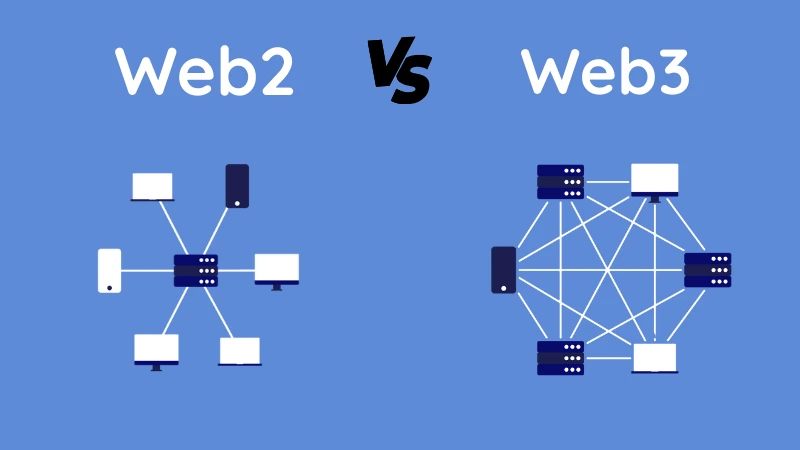
What sets Web3 apart from Web2 is its decentralized approach to data, transactions, and content control. In contrast to Web2, where intermediaries and centralized tech companies hold the power, Web3 provides control back to the users. With Web3, users have the power to control and manage their data without any intermediaries, as well as monetize it. This represents a new paradigm in Internet monetization, data management, and the functioning of web-based companies.
Trustlessness
The idea of trust varies significantly when comparing Web2 and Web3. In Web2, parties that are part of a transaction trust each other, typically with the help of a central authority. As for Web3, it is constructed on systems that need no trust between the parties. Transactions are carried out automatically when fixed conditions are met, and the data is verified, thus preserving trustworthiness without having to depend on trust directly.
Blockchain Technology
Blockchain technology is a distributed database system that enables transparent information sharing across a network. Every block has a collection of records or transactions that, after being validated, are irrevocably connected to the block before it, forming an unchangeable and ongoing ledger. Web3 uses blockchains to facilitate safe, open transactions and documentation.
Understanding these key technologies can be really daunting, especially if you are just starting out to work with Web3 projects. It is highly advisable that you go with a reputable Web3 developer to help in your journey of building decentralized applications.
Key Differences Between Web2 and Web3
| Web2 | Web3 | |
| Governance | Owned by large, centralized corporations. | Owned by a decentralized network of users and governed by communities. |
| Speed | Faster | Currently slower |
| Identity Management | Users have to maintain accounts specific to each platform. | Web3 has self-sovereign identities (SSIs), allowing users to manage a unified, secure digital identity across platforms |
| Censorship | Vulnerable to censorship and content control since a centralized organization controls operations. | It is censorship-resistant since a decentralized network controls it. |
| Data Ownership | Owned by the platform and the governing company, monetizing it through analytics and advertising. | Owned by the individual, empowering individuals to control their digital identities and interactions |
| Currency | Fiat | Cryptocurrencies or tokens. |
| Monetization | A platform-driven advertising model to generate revenue | User-driven monetization by leveraging tokens, cryptocurrencies, and smart contracts. |
| Trust | You need to trust the centralized government and large corporations | Trustless and trust built into technology through cryptography and consensus mechanisms |
| Transactions | All transactions must be made via a third party, like a financial service provider. | All transactions are made peer-to-peer, directly between users. |
| Scalability | Limited scalability with a growing user base | Scalability potential through blockchain technology |
Bottom Line
Web2 laid the foundation of today’s modern digital age with user interactivity, social networking, and user-generated content. Still, at the same time, it centralized user data and virtually provided no data ownership to its users. Web3, by contrast, introduces decentralization, accountability, and user autonomy, representing a move towards an open and trustless web.
Even if you think that it’s not the time for your business to fully transition to Web3, it is still essential to be aware of all the emerging trends and begin positioning yourself for the potential new future of the Internet so your business can be an early adopter.
If you are just getting started, then understanding all these new, different Web3 terms and technologies that it introduces can be confusing in the beginning. It would be advisable to go with some experts in the field. And, in that case, Coin Developer India can help you!