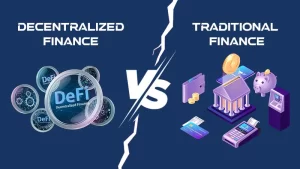





Indeed, DeFi is a rapidly growing ecosystem that’s challenging everything we know about traditional finance. DeFi, or decentralized finance, is all about taking out the middleman. Whether it’s for yield farming or using decentralized crypto exchanges, the whole idea is straightforward but really impactful.
But how does it all actually work behind the scenes? The answer lies in smart contracts!
These automated and tamper-proof programs execute transactions, enforce agreements, and manage funds, all without human interruption.
Now, the question that arises is, what is the role of smart contracts in DeFi? Let’s get the answer to this question in this blog!
But, before we move on to that, let’s begin with some basics!
An Overview of Smart Contracts
Smart contracts are basically self-executing agreements with the terms directly written into the code. These contracts operate on blockchain technology, thus named as blockchain smart contracts. It enables automated and trustless execution of predefined rules when specific conditions are met.
Nick Szabo, a well-known computer scientist and cryptographer, came up with the concept of smart contracts in the early 1990s. His idea was all about making transactions more transparent and secure. They automate the execution of transactions when predetermined conditions are met and eliminate the need for intermediaries.
Some of the key features of smart contracts are as follows:
- Self-execution
- Tamper-resistant
- Decentralization
- Trustless
- Cost-efficiency
How Smart Contracts Power DeFi?
Smart contracts are really the core of DeFi (Decentralized Finance). These are stored on a blockchain and automatically carry out actions when specific conditions are met. Here’s how they power DeFi:
Automation of Financial Transactions
In traditional finance, activities such as lending, borrowing, or trading typically necessitate the involvement of a bank, broker, or a formal approval process. Smart contracts handle these tasks by running set conditions on their own, so there’s no need for middlemen.
Trustless & Transparent Systems
All DeFi smart contracts are published on public blockchains, such as Ethereum. Unlike private blockchains, public blockchain ensures that anyone can effortlessly view, verify, and audit operations. With clear and tamper-proof rules in place, users can place their trust in the system itself, rather than relying on the individuals behind it.
Decentralized Exchanges (DEXs)
Smart contracts enable decentralized exchanges like Uniswap and PancakeSwap. They handle the entire trading process without any central authority. This makes trading quicker, cheaper, and easier for anyone who has an internet connection.
Collateral Management in Lending Protocols
Many DeFi platforms, such as Aave and Compound, utilize smart contracts to effectively manage user collateral. If a borrower’s collateral value drops too low, the smart contract will automatically liquidate it to prevent losses. This ensures risk is managed fairly and efficiently.
Yield Farming & Staking
In DeFi, people usually make money by adding liquidity or by staking their tokens. Smart contracts calculate and distribute these rewards smoothly based on participation and time. This makes DeFi platforms more attractive and rewarding for users.
Stablecoins
Stablecoins like Tether (USDT) and USD Coin (USDC) rely on smart contracts to maintain a stable value. These contracts seamlessly manage the issuance and elimination of tokens in accordance with the value of the underlying collateral. This helps keep stablecoins decentralized and lets them stay stable in price without relying on a central authority.
Insurance
DeFi insurance platforms like Nexus Mutual and InsurAce utilize smart contracts to automate coverage management, claim verification, and payout issuance. Once a claim meets predefined conditions, the smart contract executes the payout without any manual approval. This approach streamlines processes, significantly reduces costs, and enhances clarity.
Benefits of Smart Contracts in DeFi
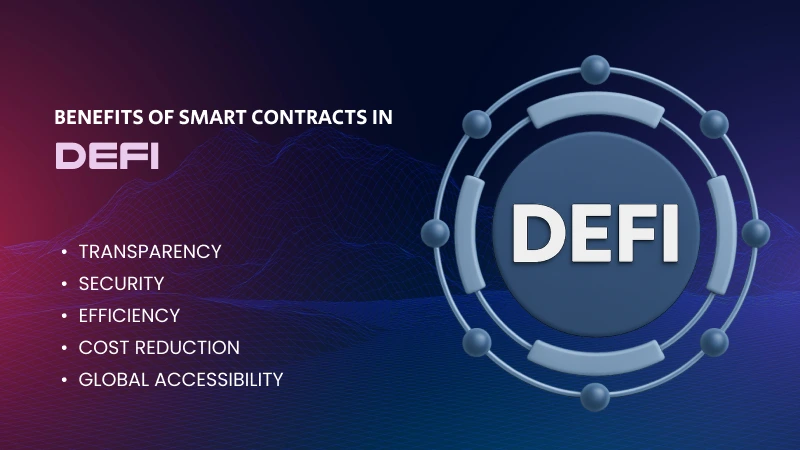
In DeFi development, smart contracts provide key advantages that help projects stand out and deliver true decentralization and efficiency. Some of them include:
Transparency
Smart contracts operate on public blockchains like Ethereum, where the contract code and transaction history are visible to anyone. This open-source nature ensures that users can independently verify how a platform works, what rules govern it, and how funds are handled. Transparency eliminates hidden terms and fosters trust by making all interactions fully auditable.
Security
Once a smart contract is deployed to the blockchain, it becomes immutable. This means that it cannot be altered or tampered with. This prevents malicious actors from changing the rules or accessing funds stored within the contract. When properly written and audited, smart contracts offer a high level of security that traditional systems often lack.
Efficiency
Smart contracts streamline processes by executing tasks automatically when certain conditions are met. You won’t have to deal with any paperwork, manual checks, or waiting around. This automation makes things easier, cuts down on mistakes, and helps decentralized applications (dApps) in the DeFi ecosystem grow faster, which gives users a smoother and quicker experience.
Cost Reduction
In the debate of smart contracts vs traditional finance, the former wins, as intermediaries like banks, brokers, and more take a cut of every transaction. That’s because smart contracts remove these middlemen by directly connecting users and executing transactions based on code. This lowers operational expenses and transaction fees, making DeFi more affordable.
Global Accessibility
One of the benefits of smart contracts in DeFi is that they enable anyone with an internet connection and a cryptocurrency wallet to participate. There are no geographic restrictions, credit checks, or banking prerequisites. This creates financial opportunities for individuals in underserved or unbanked regions.
Challenges & Risks of Smart Contracts in DeFi
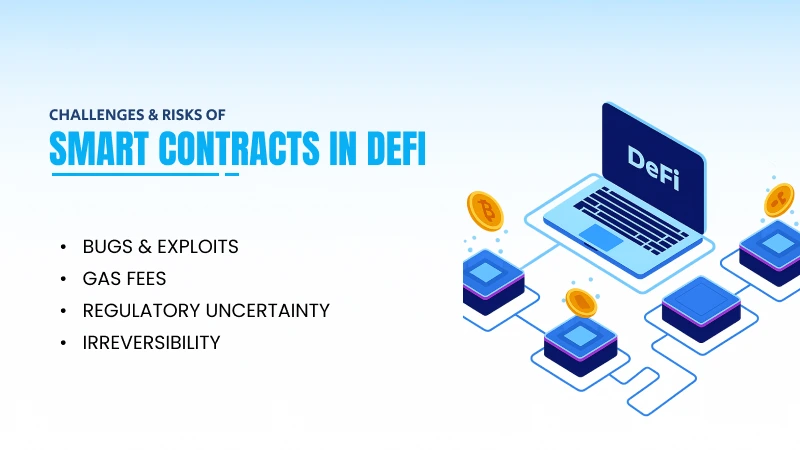
While smart contracts are key to DeFi, they also come with certain challenges and risks that you must be aware of, especially while working on your DeFi project. These include:
Bugs & Exploits
One of the biggest risks with smart contracts is that there can be bugs or weaknesses in the code. Since these are self-executing and immutable once deployed, any loophole can be exploited by malicious actors, often resulting in significant financial losses. It can even result in high-profile DeFi hacks. Thus, rigorous testing and third-party audits are essential to minimize these risks.
Gas Fees
Gas fees can become expensive during periods of high demand. These network fees are required to execute smart contract operations, and when they rise, they can discourage users from interacting with DeFi platforms. This impacts scalability and accessibility, especially for smaller investors or users. Layer-2 scaling solutions and alternative blockchains are being used to address this problem.
Regulatory Uncertainty
The legalities around DeFi and smart contracts are still very unclear, and they even vary across jurisdictions. Governments and regulatory bodies are still developing frameworks to govern decentralized applications, which creates uncertainty for developers and users. A lack of clarity on compliance, taxation, and consumer protection can lead to legal consequences if rules are violated.
Irreversibility
Smart contracts are designed to be immutable, which means once they are deployed on the blockchain, they cannot be easily altered. This guarantees a trustless environment and tamper-resistance; however, it also implies that any faulty contracts or logical errors cannot be rectified without deploying a completely new contract. This inflexibility can lead to permanent losses or operational disruptions.
Wrapping Up
That’s a wrap for this blog!
Smart contracts play an important role in the DeFi revolution. And these self-executing lines of code are changing how we interact with financial systems.
And do you know what the best part is? They are revolutionizing finance to create a system that is more transparent, equitable, and accessible to everyone.
As DeFi keeps expanding, smart contracts are going to become even more important in creating a future where we don’t need middlemen.
Are you looking for assistance for your DeFi project? Reach out to the experts at Coin Developer India; we can guide you!