




You must have heard about layers in blockchain, but didn’t know what it meant. It is one of the most used terms in the blockchain space around scalability. As any blockchain network becomes popular, it experiences slower transaction speeds, leading to delayed confirmation and high transaction fees. To overcome this issue, there are layers introduced in blockchain.
In this blog, we are going to discuss the different layers of blockchain, how they interact with each other, and what their differences are. Understanding these layers is crucial for anyone in the blockchain ecosystem, so let’s get started.
A brief overview of Layers in Blockchain
Before talking about layers in blockchain, let’s know about blockchain. A blockchain is a decentralised digital ledger that is maintained by independent nodes, each recording and verifying transactions on an immutable chain.
The reason that we have these layers is scalability. As blockchains like Bitcoin become popular, they are faced with congestion, which slows down the transaction confirmation waiting period. This is the side effect of popularity, and to fix these congestion-related issues, scalability solutions are introduced. This is why we have all these different layers.
Imagine this as adding more lanes or creating express routes. Some of these lanes offload these transactions to side routes, and some operate on the base layer. This base layer is referred to as L1.
What is Layer 1?
In a decentralised blockchain ecosystem, L1 or layer 1 refers to the basic primary blockchain network. This is where all the transactions are processed.
Layer 1 blockchains like Bitcoin, Ethereum, and Solana are the functional networks responsible for the core functions, such as consensus mechanisms, transaction processing and validation.
This layer handles everything from transaction processing to smart contracts execution, but as they grow, they face scalability issues resulting in slower transaction times and higher fees. To overcome all these drawbacks, we use layer 2 solutions.
See more: How to Implement of Blockchain Technology in Businesses
What is Layer 2?
Layer 2, which is most commonly referred to as L2, is like an express route that is built on layer 1. Layer 2 solutions are built as extensions of mainchains and depend on their security framework. It makes transactions cheaper and faster without changing the base layer. This layer optimises the overall efficiency of blockchain.
It is a third-party integration that continues to work on the upper end of a layer 1 blockchain to help scale a proposal by processing transactions outside of the main blockchain (L1) while preserving the very same stability and decentralisation. For example, the Lightning Network is a layer two solution for Bitcoin.
How Do Layer 1 and Layer 2 Interact
The layer 1 and layer 2 work together to enhance the overall efficiency of the blockchain system. Both layers work through a relationship where layer 2 works on top of layer 1. While layer 1 provides a secure and decentralised foundation, layer 2 offers the scalability and speed necessary for mass adoption.
This synergy allows for the support of complex and high-value applications to be built and operated, paving the way to faster and more efficient mainstream blockchain adoption.
A sidechain, such as Ethereum, is a secondary blockchain that runs in parallel to the main L1 chain. What separates layer 2 solutions and sidechains is that sidechains are separate blockchains connected to the mainchain, each with its own consensus method.
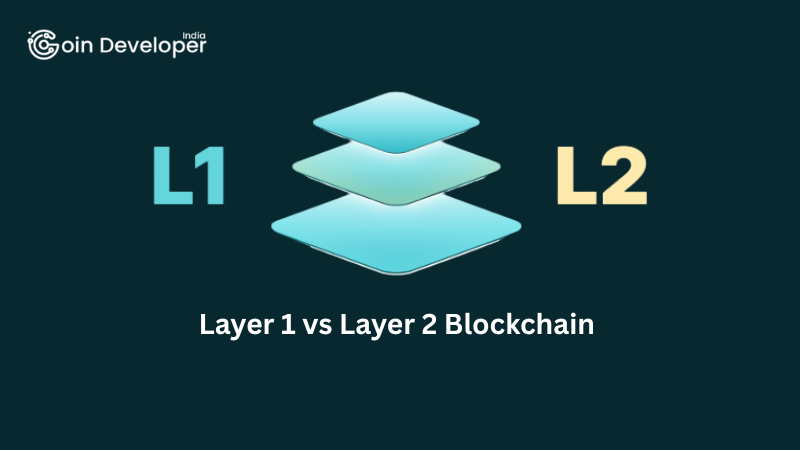
Layer 1 Blockchain Vs. Layer 2 Blockchain: Comparing Benefits?
Check out some advantages of Layer 1 and Layer 2 blockchain scaling solutions:
| Criteria | Layer 1 | Layer 2 |
| Definition | By definition, L1 are the foundational networks that are responsible for core functions like consensus mechanisms, transaction validation and block creation. | L2 are the networks or solutions that operate on top of the L1 blockchain, conducting transactions and executing contracts off-chain. |
| Objective | It focuses on modifying the underlying blockchain protocol to achieve scalability, prioritising decentralisation and security. | Aims to reduce the load of layer 1 by processing transactions off-chain, focusing on scalability and transaction throughput. |
| Benefits | Enhances network security, decentralization, and trustless execution. | Offers higher transaction throughput with lower transaction fees. |
| Examples | Blockchain, Solana, and Ethereum. | Polygon, Arbitrum, and Lightning Network. |
Conclusion
Understanding the different characteristics of Layer 1 and Layer 2 solutions is necessary to understand how blockchain networks scale when the demand goes up. Layer 1 blockchains offer security and decentralization, whereas Layer 2 blockchains offer speed and cost efficiency, which are important for mass adoption.
As the blockchain space continues to evolve, businesses are faced with the decision of which layer would suit their objectives. So, whether you are planning to make a scalable or more secure blockchain, a blockchain development company can help you make the correct decision.