




Have you ever wondered what the internet would look like if we users, held the real power to control it and not some big corporations? What if your data, identity and even money could be managed without relying on any middlemen? That is exactly the kind of future that Web 3.0 is shaping.
Web 3.0 is the most recent iteration of the internet, and it has already completely shaken up the tech industry to its core. It changes the internet from the ground up, making it a whole lot more user-centric and giving more power to the end-user like you and me.
In this blog, we are going to see how Web 3.0 evolved from Web 2.0, its core features, how it is changing the internet in 2025, and the different industries that it is revolutionizing.
The Web 3.0 Evolution from Web 2.0
Web 3.0 is the third iteration of the World Wide Web. Web 2.0 played its role in making the internet more accessible to a broader audience and allowed for the active participation of users in its formation. People enjoyed the connectivity, allowing everyone to be just a text away; gone were the days of the telephone or writing letters by hand and waiting for the recipient to receive them.
However, a significant downside with Web 2.0 was that people became puppets for big tech corporations that create Web 2.0 applications; buried deep in the fine print of their terms and conditions was a clause allowing these companies to own and exploit users’ data. These companies generated revenue by exploiting user data for their own financial gain.
The key difference between Web 2.0 and Web 3.0 is that Web 3.0 is decentralized, meaning that users’ data is not stored in one central server; instead, it is spread across multiple peer-to-peer connections, giving them more control and privacy. It is all about users getting freedom of choice and control over whom they want to share their data with.
Core features of Web 3.0
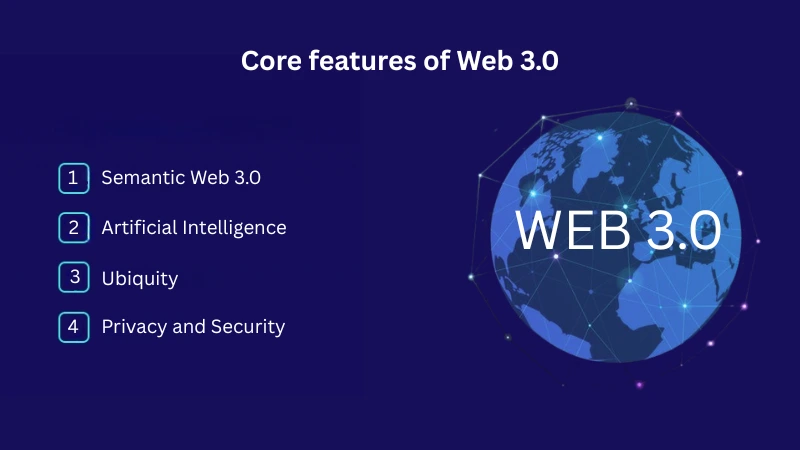
To better understand the impact of Web 3.0 on the internet, it is crucial that we are aware of its core features:
Semantic Web 3.0
The word “Semantic” means that something understands the meaning and emotions behind a word. For instance, we can say:
- I love eating pineapples.
- I ❤️ eating pineapples.
Both sentences have different appearances, but they all carry the same meaning behind them. Web 3.0 will also enable computers to fetch data from various sites and serve information to the users in a more human-like manner.
Artificial Intelligence
Web 3.0 will be implementing AI to simulate human-like intelligence, like natural language processing (NLP), speech recognition, and computer vision. It is essential to mention that the current Web 2.0 also uses AI, but most of it is human knowledge-based, and it is highly susceptible to fraudulent and false information. For instance, a firm selling its products on multiple online platforms can manipulate the ratings by paying people to give them feedback.
AI in Web 3.0 enhances personalized user experience through advanced data analysis of large volumes of data sets generated on Web 3.0 platforms, providing usable insights and supporting data-driven decision-making.
Ubiquity
Ubiquity is the fact of being present everywhere, and internet connectivity has made its presence speak for itself in every corner of the world, with everything running over the internet. Let’s be real, Web 2.0 is also ubiquitous because of social networks, but that depends on whether you have an internet connection.
Web 3.0 is a notch above its predecessors; with the evolution of the Internet of Things (IoT), the internet is finding its implementation in our daily lives, in things like coffee machines, smart thermostats, wearable devices such as fitness trackers and smartwatches, connected vehicles, and industrial sensors for manufacturing and agriculture, not just smartphones and computers.
Privacy and Security
Web 3.0 enhances users’ privacy and online surveillance in many ways. Users now have a greater degree of control over their data and can decide where they want it to be shared with third parties or not. Data breaches and leaks have been drastically reduced with Web 3.0, as it uses blockchain and its immutable ledger, making it significantly more difficult for information to be leaked.
In Web 3.0, data is stored across multiple networks of computers, connected in a peer-to-peer manner across the world. There are several security protocols in place with Web 3.0, which include blockchain technology and cryptographic hashing for data integrity, smart contracts for automation and performing secure transactions, and protocols like IPFS for distributed storage.
Ways Web 3.0 is Changing the Internet in 2025
Now, let us examine some of the top use cases of the Web 3.0 technology that is revolutionizing the internet.
Revolutionizing The Banking Sector
Web 3.0 is revolutionizing the banking sector with the introduction of decentralized finance. The DeFi platforms are for lending, borrowing, and trading without any intermediaries. Smart contracts automate every transaction with excellent transparency and security through an immutable ledger that allows anyone on the network to audit it.
Web 3.0 is breaking barriers by making financial services accessible to most of the population, even those who are not covered by the centralized banking sector. It also fosters financial innovation features like yield farming, liquidity pools, and decentralized insurance, giving users options to explore novel ways of growing and managing their wealth.
Ownership and Digital Identity
Web 3.0 introduces Decentralized Identity Management systems, wherein users can control their personal data. Blockchain networks like Polygon and Ethereum provide a framework for self-sovereign identities and data ownership, which eliminates the need for centralized data repositories.
NFTs are another Web 3.0 technology that provides ownership using a blockchain ecosystem. Blockchain ensures the authenticity and the limitedness of NFTs, giving creators a direct platform where they can monetize their work. It removes the need for intermediaries, allowing creators and buyers to interact directly. Web 3.0 changes digital ownership and empowers creators.
Decentralized Social Media and Creator Economy
Web 3.0 is changing social media networking with dApps that prioritize users’ control and privacy. Web 3.0-based social media and protocols, like Farcaster, allow users to own their data using different clients or applications. Mastodon is an open-source, decentralized microblogging platform operating on a network of independent networks.
Web 3.0 also empowers the creator economy through direct-to-fan monetization with the help of NFTs and tokenized content. A smart contract-based loyalty system and creator economy uses self-executing code on a blockchain network to automate transactions between creators and their audience, eliminating intermediaries taking their cut.
Decentralized Infrastructure
It would be an understatement if we said that Web 3.0 is the future of decentralized technology. It is revolutionizing data storage by enabling decentralized storage solutions like IPFS, Filecoin, etc. These platforms distribute data across Web 3.0 nodes to ensure security and redundancy. Web 3.0 also enhances data privacy, reducing the risk of data breaches and downtime.
Web 3.0 enhances privacy-first browsing and communication through decentralized storage solutions, moving away from centralized entities that collect user data and process it. Key technologies include SSIDs, zero-knowledge proofs, decentralized storage networks, and encrypted communication protocols, reducing breaches and censorship.
Governance and DAO
DAOs are at the forefront of blockchain business building, and there is no way we can list Web 3.0 use cases without mentioning them. So, Web 3.0 transforms governance structure with DAOs, which operate on blockchain-based smart contracts. They enable decentralized decision-making where community members cast a vote on proposals collectively.
In 2025, some real-world examples of DAOs’ success include Uniswap DAO funding, a community-led initiative, the MakerDAO for managing billions in DeFi and the rise of Venture DAOs like CellarDAO Society for wine investment. This shows that DAO tooling is being accepted in more and more industries.
Final Thoughts
We have seen different ways in which Web 3.0 is changing how we interact with the internet. It empowers users by giving them more control, privacy, and security. Web 3.0 use cases are in every field of the internet, from digital ownership and digital identity to decentralized finance.
The best move that you can make for your company in 2025 will be to invest in Web 3.0 solutions since they will future-proof your business and present new opportunities. Partnering with a reliable Web 3.0 partner can help you adapt your current technologies to this new internet paradigm.
At Coin Developer India, our commitment lies in assisting businesses and innovators to fully utilize Web 3.0’s potential, enabling them to create future-ready solutions. We have already helped multiple firms transition to Web 3.0.
Get in touch with us now!