




Finance has always been about trust. We trust banks, middlemen, and those centralized institutions to handle our money for us. What if we could set up a system where there’s no waiting on middlemen, no delays, and no surprise fees?
That would be awesome, right? Want to know what it could be? Well, that’s DeFi!
In recent years, DeFi has become a strong alternative to the traditional financial systems that we have relied on for decades. With growing global interest and adoption, the number of DeFi users is projected to reach 213 million by 2026. This shows how rapidly this decentralized movement is gaining ground.
But how does it really stand against the tried-and-tested methods of traditional banking that we have been using for years? Want to know? That’s what this blog is all about!
In this blog, we’ll discuss the differences between DeFi and traditional finance, such that by the end you know who won the race.
Let’s get started!
An Overview of Traditional Finance (TradFi)
Traditional finance is the well-established financial system that people use every day. It includes banks, insurance companies, stock exchanges, and governments that act as financial intermediaries that further help in facilitating financial services like saving, lending, investing, and transferring money.
It basically operates on trust in institutions. For instance, when you deposit your hard-earned money into your bank account, you trust that the bank will protect your money and allow you to access them when needed. Similarly, when applying for a loan or investing in the stock market, there are regulations, approval steps, and third parties involved.
Some of the features of traditional finance are:
- Centralization: A single organization controls and manages funds.
- Regulation: Activities follow financial laws from different countries.
- Intermediation: Transactions need intermediaries like banks, brokers, or clearinghouses.
- Limited Access: Participation can depend on location, income, credit, or regulations governing the country.
What Is DeFi (Decentralized Finance)?
Decentralized Finance (DeFi) is a financial innovation that is built on blockchain technology. It removes the need for traditional banking systems and other intermediaries, such as brokers, agents, and insurance companies. DeFi uses smart contracts to manage financial activities instead of centralized institutions.
DeFi gives users full control over their assets and financial decisions. No matter whether you are borrowing, lending, trading, earning interest, or buying insurance, DeFi allows you to do so directly through decentralized applications (dApps) without needing permission from any central authority.
Some of the features that define DeFi are as follows:
- Decentralization: Operates without a central governing body.
- Transparency: All transactions and contract logic are publicly viewable on the blockchain.
- Interoperability: Different DeFi platforms and protocols can often work together seamlessly.
- Programmability: Financial logic is coded into smart contracts for automation and flexibility.
- Accessibility: Participation is open to anyone with internet access and a cryptocurrency wallet.
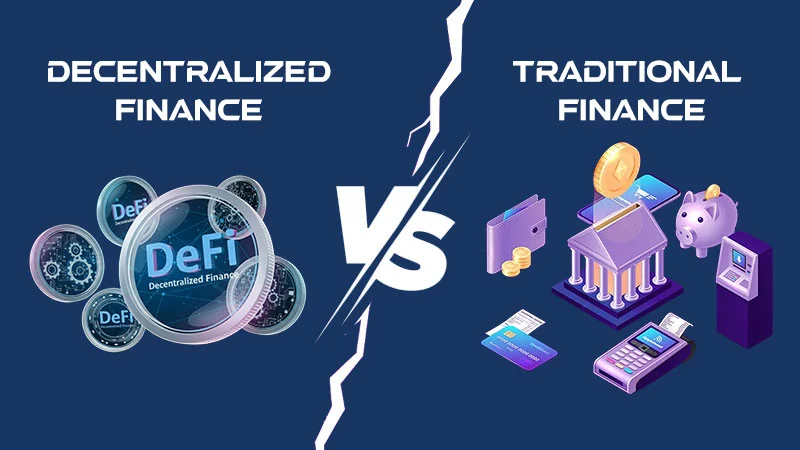
Decentralized Finance vs Traditional Finance: Core Differences
If you are still stuck between is DeFi better than traditional banking, then here’s a quick DeFi comparison with traditional finance for you. Have a look!
Centralization vs Decentralization
Traditional finance is completely centralized. This means that financial entities, such as banks and payment processors, serve as intermediaries. They manage transactions and control user funds.
On the other hand, DeFi runs on decentralized blockchain networks where smart contracts have the power to replace middlemen. Users have complete control over their digital assets and can connect directly using dApps.
Accessibility
TradFi services are often limited by geography, banking infrastructure, credit history, and regulatory barriers. Access can be difficult for people in underbanked or developing regions.
DeFi is available for anyone who has an internet connection and a crypto wallet. This means people can avoid the hassle of paperwork, credit checks, and lengthy approval processes.
Transparency
One of the cons of traditional finance is that it lacks transparency. Bank processes and transaction details are basically private and fully controlled by the centralized institutions.
DeFi operates on public blockchain networks where every transaction and contract is visible and verifiable. This ensures transparency and accountability.
Control Over Funds
In traditional finance, your money is held and managed by third parties. You need to request access, and in some cases, institutions can freeze or limit your funds.
With DeFi, users have complete ownership of their funds and can manage them directly through wallets and smart contracts, without relying on any third party.
Speed & Efficiency
TradFi transactions, especially cross-border transfers or settlements, can take days and involve multiple intermediaries.
DeFi transactions are executed almost instantly or within a few minutes. That’s all possible due to blockchain automation and the absence of middlemen.
Costs and Fees
Traditional finance involves various fees, such as processing fees, service charges, and commissions. That’s due to the fact that multiple intermediaries are involved in the process.
DeFi offers lower fees by cutting out intermediaries, although network congestion can result in high gas fees at times.
DeFi vs Traditional Finance: Key Differences at a Glance
Are you in a hurry? Let’s take a look at the core differences between them quickly!
| Aspect | Traditional Finance | Decentralized Finance (DeFi) |
| Control | Centralized institutions control assets and transactions. | Users control assets via smart contracts on blockchain. |
| Accessibility | Requires ID verification and bank accounts. | Open to anyone with internet access and a crypto wallet. |
| Intermediaries | Banks, brokers, and other middlemen are involved. | No intermediaries; automated by smart contracts. |
| Operating Hours | Limited to business hours and closed on holidays. | 24/7 operation with no downtime. |
| Cost | Higher fees due to intermediaries and admin costs. | Lower fees; mainly network/gas costs. |
| Transaction Speed | Often slow due to manual approvals and legacy systems. | Near-instant execution thanks to automation. |
| Ownership | Institutions hold and manage assets. | Users have full ownership and custody of their assets. |
Advantages of Choosing DeFi Over Traditional Finance
Still thinking, “Can DeFi replace traditional finance?” The answer is yes! The below-mentioned are some benefits of choosing DeFi over TradFi:
Full Ownership & Control of Funds
Decentralized finance allows users to fully control their digital assets with crypto wallets. This removes the need for banks or intermediaries. You don’t need to wait hours for approval to access your money or make transactions. This kind of self-custody lets people take control of their money on their own and keep it safe whenever they want.
Global Accessibility
DeFi platforms are accessible to anyone with an internet connection and a crypto wallet. You don’t need a bank account, a credit check, or an identity card. This opens financial services to people in underserved or unbanked regions, which makes DeFi a powerful tool for global financial inclusion and equal access to economic opportunity.
Transparency and Trustlessness
All DeFi-based transactions and smart contract rules are recorded on public blockchains. This transparency allows anyone to verify how platforms work and how funds are handled on the platform. Since DeFi removes intermediaries, users rely on code rather than trusting third parties, which reduces the risk of fraud or hidden processes.
Lower Costs
DeFi reduces costs by cutting out intermediaries like banks and brokers. Smart contracts make it easier to handle transactions, which can help cut down on fees you might pay when lending, borrowing, or trading. While gas fees matter, DeFi platforms usually provide cheaper services than traditional systems.
Speed & Efficiency
DeFi operates 24/7. This allows quick, automatic transactions without the delays of traditional banking hours or manual approvals. Transferring funds or borrowing assets typically takes only minutes, significantly outpacing traditional systems that often require days to complete.
More Earning Opportunities
DeFi introduces different ways to earn income, such as staking, liquidity mining, and yield farming. These models allow users to put their assets to work and generate returns directly from the protocol. It is a more dynamic and accessible alternative to traditional savings or fixed-income investment options.
Interoperability & Composability
DeFi platforms are designed to work together like building blocks. Users can combine different protocols and dApps to create customized financial solutions. This open structure fosters innovation and flexibility, and these are features that are rarely found in the closed systems of traditional finance.
Successful Examples of DeFi Projects Replacing Bank-like Functions
Looking for successful DeFi platforms that have effectively replaced traditional financial systems? Here are a few you should explore for inspiration as you develop your own DeFi platform.
Uniswap

Uniswap is a decentralized exchange (DEX) that allows users to trade cryptocurrencies directly without relying on centralized intermediaries like traditional stock exchanges or banks. It uses automated liquidity pools, which enable instant, peer-to-peer token swaps with lower fees and greater accessibility than conventional trading platforms.
Aave

Aave is a decentralized platform for lending and borrowing crypto. Users can use this platform to lend their digital assets to earn interest or borrow funds by using their holdings as collateral.
It functions without banks or credit checks, using smart contracts to automate loans, interest rates, and repayments.
MakerDAO / DAI

MakerDAO is a decentralized protocol that manages the issuance of DAI, which is a stablecoin pegged to the US dollar. Unlike traditional banks that issue fiat currencies, this platform uses smart contracts to maintain DAI’s stability.
This facilitates decentralized borrowing and lending without the need for intervention from a central authority.
Compound

Compound is a decentralized lending platform where people can lend their cryptocurrencies to liquidity pools and earn some interest on them. Borrowers have the opportunity to secure loans by offering valuable assets as collateral, and this entire process is seamlessly managed through the use of smart contracts.
This system replicates bank lending functions but operates without intermediaries or lengthy approval processes.
Curve Finance

Curve Finance is a decentralized exchange that has been specifically designed for optimized stablecoin trading and to facilitate low-slippage swaps. It provides users with effective methods to trade stablecoins and generate interest by supplying liquidity.
It replaces traditional banking services like currency exchange and savings accounts with faster, transparent, and decentralized alternatives.
The End Note
That brings us to the end of this blog!
The financial world is changing and fast. While traditional finance has served us for decades, it often comes with limitations. And DeFi is flipping the script by offering a system that’s open, transparent, and driven by technology.
Be it that it is about lending, borrowing, trading, or earning passive income, DeFi puts the power back in the hands of users. Of course, DeFi is still evolving and comes with its own risks, but the benefits are hard to ignore.
If you are excited about the future of decentralized finance and want to explore its integration into your DeFi project, reach out to the experts at Coin Developer India!