




Remember the time when creating a cryptocurrency meant coding an entire blockchain from the ground up? Well, those days are long gone.
Today, you can create your own token in a matter of minutes. All credit goes to smart-contract templates, token-launcher platforms, and powerful blockchain ecosystem frameworks.
In 2026, the real challenge isn’t building a blockchain. It is about choosing the right one. Obviously, it is one of the main decisions you will make when launching your crypto.
So, are you looking to choose one of the best blockchains for your crypto project? Don’t worry, here’s a blog for you!
In this blog, we will talk about the best blockchains and how to choose one. Here we go!
What to Consider Before Choosing a Blockchain
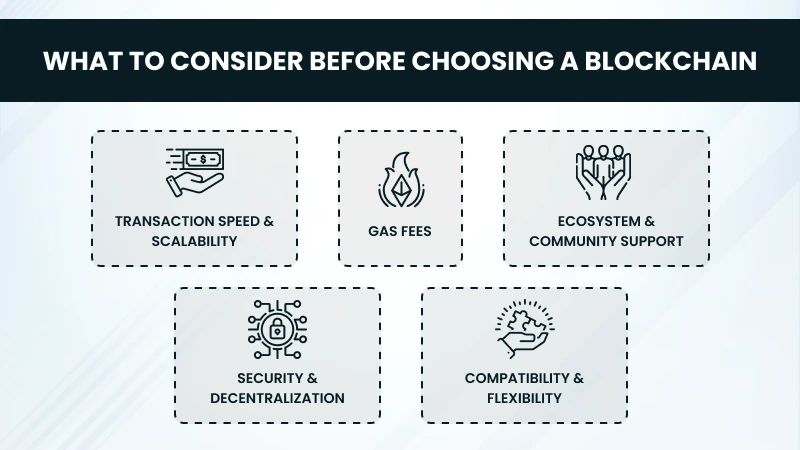
Choosing the right blockchain plays an important role. Thus, before you launch your cryptocurrency, here are the key factors you should think through:
Transaction Speed & Scalability
Transaction speed and scalability are crucial if you want your token to handle high traffic without frustrating users. Some of the blockchains can process thousands of transactions per second, while others might take minutes for the same.
If the purpose of your cryptocurrency includes everyday payments, microtransactions, or high-volume trading, you can go ahead with a blockchain that supports a fast network, as it ensures a smooth user experience.
Gas Fees
Transaction fees, or gas fees, can significantly impact both you and your users. On some networks, every transfer or smart contract execution can cost a small fortune, which can discourage adoption, especially for microtransactions.
On the other hand, low-fee blockchains make it affordable to move tokens frequently.
Ecosystem & Community Support
Blockchain platforms that have a strong developer community provide ready-to-use tools, tutorials, and active forums, which make it easier to deploy, maintain, and improve your cryptocurrency.
Communities in the space also attract projects, crypto exchange platforms, and users. Choosing the right blockchain platform can save you time and minimize errors.
Security & Decentralization
A widely distributed blockchain with many nodes is usually more secure against attacks, censorship, and failures. However, some of the high-speed blockchains compromise decentralization for faster transactions.
It is essential to evaluate the level of risk you are prepared to accept in relation to the advantages of rapid execution. Select a blockchain that strikes the right balance and aligns with the goals of your project.
Compatibility & Flexibility
If you want your token to interact with other platforms or decentralized apps (dApps), compatibility plays an important role. For example, EVM-compatible chains allow your token to integrate seamlessly with Ethereum-based tools, wallets, and DeFi platforms.
Some blockchains offer unique features, like cross-chain interoperability or advanced smart-contract functionality, but may have a smaller user base.
Top Blockchains to Create Your Cryptocurrency in 2026
Before we talk about each blockchain in detail, let’s take a quick look at each one!
| Blockchain | Native Token | Consensus Mechanism | Key Strengths | Ideal For |
| Ethereum | ETH | Proof of Stake (PoS) | Largest ecosystem, smart contracts, DeFi & NFTs | General-purpose tokens, DeFi, NFTs |
| Binance Smart Chain | BNB | Proof of Staked Authority (PoSA) | Low fees, EVM-compatible, huge user base | Utility tokens, fast DeFi apps |
| Polygon | MATIC/POL | Proof of Stake (PoS) + zkEVM L2 | Scalable Ethereum Layer-2, low fees | Scalable dApps, gaming, DeFi |
| Solana | SOL | Proof of History + PoS | Extremely fast (~65k TPS), low-cost transactions | High-speed dApps, gaming, payments |
| Avalanche | AVAX | Snowman/Avalanche Consensus (PoS) | High throughput, customizable subnets | Enterprise tokens, DeFi |
| Tron | TRX | Delegated Proof of Stake (DPoS) | High speed, low fees, popular for stablecoins | Payments, entertainment apps |
| Cardano | ADA | Ouroboros PoS | Strong research base, sustainable infrastructure | Environmentally friendly tokens |
| Arbitrum | ARB | Layer-2 (Optimistic Rollup on Ethereum) | Low gas, Ethereum security, 35%+ L2 market share | Ethereum-based DeFi and tokens |
| Sui | SUI | Proof of Stake | High parallelization, new programming model | Gaming, interactive NFTs |
| Stellar | XLM | Stellar Consensus Protocol (SCP) | Focused on cross-border payments | Payment tokens, remittances |
Now, here is a detailed breakdown of each blockchain network to build your token or coin this year:
Ethereum
Ethereum remains the leading blockchain for decentralized applications and token creation in 2025. Its strong smart contract features, big community of developers, and well-established ecosystem make it a great choice for creating new cryptocurrencies.
The Ethereum 2.0 upgrade, along with the switch to proof-of-stake, helps speed up transaction processing and reduce energy consumption. Its ERC-20 standard sets the benchmark for token creation, which ensures compatibility across thousands of wallets and decentralized exchanges.
Pros:
- Largest ecosystem and developer base
- Highly secure and widely supported
- Rich infrastructure for DeFi and NFTs
Cons:
- High gas fees
- Network congestion at peak times
Binance Smart Chain

BNB Chain is a fast, low-fee, and EVM-compatible blockchain that enables easy token creation using familiar Ethereum tools. It offers seamless integration with Binance’s vast ecosystem, including exchanges, DeFi apps, and crypto wallets.
Its Proof of Staked Authority system enables fast transactions and low costs. This makes it ideal for entrepreneurs looking to deploy scalable and cost-efficient crypto projects quickly.
Pros:
- Low fees and high speed
- Easy deployment using Ethereum-compatible tools
- Strong Binance ecosystem support
Cons:
- Centralization concerns
- Less decentralized than Ethereum
Polygon

Polygon functions as an Ethereum Layer-2 scaling solution, which provides fast and cheap transactions while maintaining Ethereum compatibility. It supports both Proof-of-Stake and zkEVM for enhanced scalability and security.
Developers can easily deploy ERC-20 tokens with minimal fees. Polygon is really gaining traction in the DeFi, gaming, and NFT spaces. It’s a popular choice because it provides Ethereum’s benefits without the high gas fees.
Pros:
- Low fees and fast confirmation
- Ethereum compatibility
- Scalable for dApps and games
Cons:
- Depends on Ethereum for security
- Occasional network congestion
Solana

Solana is known for being super quick with transactions and having really low fees. This is mainly because it uses a mix of proof-of-history and proof-of-stake. It is designed for high-performance applications such as gaming, DeFi, and micropayments.
Developers create new cryptocurrencies using the SPL token standard. Solana’s expanding ecosystem is attracting innovative projects seeking fast and scalable solutions.
Pros:
- Extremely fast and inexpensive
- Great for high-frequency apps
- Growing ecosystem
Cons:
- Occasional network outages
- Less decentralized validator network
Avalanche

Avalanche is a fast blockchain platform that provides customizable subnets and quick transaction finality. The Snowman consensus effectively manages a high volume of transactions per second while ensuring minimal energy consumption.
Developers can deploy Ethereum-compatible smart contracts using the C-Chain or build their own blockchains on custom subnets. It is ideally suited for businesses, decentralized finance (DeFi) applications, and scalable financial products that demand both high throughput and versatility.
Pros:
- Extremely fast and scalable
- Supports custom blockchains
- Energy efficient
Cons:
- Smaller ecosystem compared to Ethereum
- Complex for beginners
Tron
Tron focuses on high-speed and low-cost blockchain transactions, which makes it popular for entertainment, payments, and stablecoin issuance. It uses Delegated Proof of Stake (DPoS) to achieve high throughput and energy efficiency.
Developers can issue TRC-20 tokens easily, similar to Ethereum’s ERC-20. Its large user base and established DeFi ecosystem make Tron a better cryptocurrency for consumer-facing apps and fast, cost-effective token creation.
Pros:
- High speed and low cost
- Strong for stablecoins and payments
- Large active community
Cons:
- Centralization issues
- Less innovative than newer blockchains
Cardano

Cardano, powered by the Ouroboros Proof of Stake protocol, focuses on academic research, peer-reviewed technology, and sustainability. It offers a secure and eco-friendly environment for smart contracts and token creation using the native ADA coin.
Developers use Cardano’s native multi-asset ledger to issue tokens without smart contracts. Its focus on scalability, interoperability, and formal verification makes it appealing for enterprises and eco-conscious projects.
Pros:
- Energy-efficient and secure
- Strong research foundation
- No need for smart contracts to mint tokens
Cons:
- Slower development pace
- A smaller ecosystem than Ethereum
Arbitrum

Arbitrum is a Layer-2 scaling solution built on Ethereum that offers faster and cheaper transactions using optimistic rollups. It takes Ethereum’s security and makes it a lot cheaper to use by cutting down on those gas fees.
Developers can easily launch ERC-20 tokens and dApps with the same tools used for Ethereum. Arbitrum is an excellent choice for DeFi projects, token launches, and apps needing low fees and high security.
Pros:
- Low gas fees and fast speed
- Ethereum-level security
- Full EVM compatibility
Cons:
- Relies on Ethereum’s mainnet uptime
- Smaller ecosystem than Layer-1
Sui

Sui is a next-generation Layer-1 blockchain that is designed for high throughput and instant transaction finality. Its object-focused approach simplifies the management of multiple tasks simultaneously.
The Move programming language allows developers to create tokens, NFTs, and complex applications. Sui’s quick response time and user-friendly design are really making it a popular pick for gaming and interactive Web3 apps.
Pros:
- Extremely fast and scalable
- Unique object-based architecture
- Ideal for games and NFTs
Cons:
- New ecosystem
- Learning curve with the Move language
Stellar

Stellar specializes in cross-border payments and tokenized assets. Its Stellar Consensus Protocol ensures fast, low-cost, and secure transfers across global networks.
Developers can issue custom assets and stablecoins directly on-chain. Stellar’s focus on financial inclusion, partnerships with payment providers, and ease of token creation make it a top choice for global financial tokens.
Pros:
- Fast and inexpensive transactions
- Great for payment and remittance tokens
- Trusted by enterprises
Cons:
- Limited smart contract capabilities
- Scalability issues
How to Choose the Right Blockchain for Your Project
Selecting the right blockchain is one of the most important steps, especially when you want to develop cryptocurrency. The ideal platform depends on your project’s purpose, target users, and technical requirements. To simplify your decision, here are some tips:
- For DeFi Tokens: Ethereum, BNB Chain or Polygon are excellent choices due to their scalability, low transaction fees, and strong decentralized finance ecosystems.
- For NFTs or Gaming: Solana and Sui offer quick performance and low costs, making them perfect for gaming projects and NFT marketplaces.
- For Enterprise-Grade Coins: Avalanche and Ethereum are leading blockchain platforms that offer strong security, useful developer tools, and the adaptability needed for large-scale business solutions.
- For Cross-Border Payment Coins: Stellar and Tron stand out for their fast transaction processing and cost-effective global payment capabilities.
The End Note
That brings us to the end of this blog!
The world of blockchain offers endless opportunities for creators, innovators, and entrepreneurs. From Ethereum’s vast ecosystem to Solana’s blazing speed and Polygon’s scalability, every blockchain brings its own strengths to the table.
The real challenge lies in choosing the one that best fits your project’s purpose. No matter which path you take, remember that building a successful cryptocurrency will bring your long-term vision to life.
And if you are looking for the right guidance, the experts at Coin Developer India can help you. We can help you choose a blockchain that aligns with your blockchain project needs and goals.
Get in touch with us now!