




Have you ever thought about why some blockchains are open to everyone, while some remain tightly controlled behind digital walls? Understanding the difference between public and private blockchains is key when you want to choose the right path for your business or project.
In this blog post, we are going to cover some of the main key differences between public and private blockchains, address some misconceptions about public blockchains and how they can maintain security in industries such as finance, government, military, healthcare, etc.
But before we get into the differences, let us first understand what a blockchain is and how it works.
What Is Blockchain?
First created in early 2008, blockchain is a digital shared database or ledger that is immutable, meaning that you cannot change the records of any transaction as it is spread across a vast network of computers.
It is essential to note that each block that contains data is interlinked, forming a uniform sequence through a cryptographic hash, generating a secure chronological sequence. Just like a domino effect, if one block is tampered with or changed, the whole blockchain will come crumbling down.
See Related: Implementation of Blockchain Technology in Businesses
How Does Blockchain Work?
Now, coming to the working of the blockchain, the transactions enter the blockchain network and all the information that needs to be transmitted is doubly encrypted using public and private keys.
The transaction is then submitted to the network that is formed by a network of peer-to-peer distributed computers, and they check parameters like the validity of the transaction, whether they have sufficient balance to carry out the transaction or not.
Net is the formation of a new block to be added as soon as the transaction is verified and declared as a legitimate transaction; it gets added to the mempool at a particular node. This block is added to the existing blockchain, and the transaction is completed.
Types Of Blockchain Networks
There are mainly two types of blockchain networks, namely they are, public and private. Let’s learn about these two kinds of blockchains in a little more depth:
What Is a Public Blockchain?
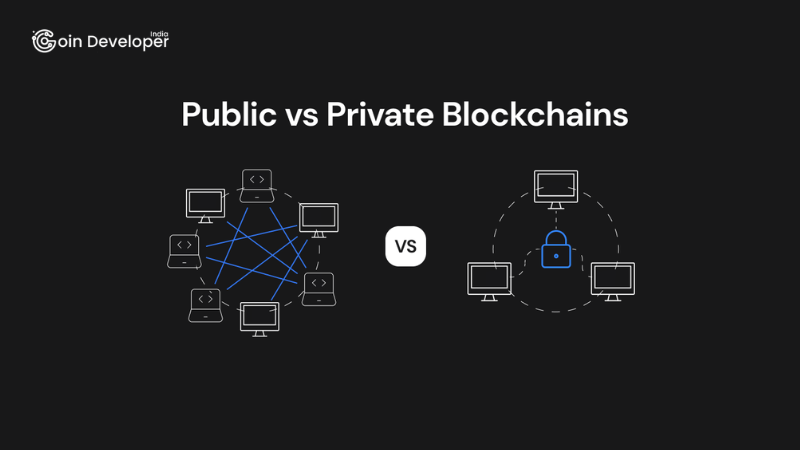
A public blockchain is a transparent and secure way of recording transactions on a digital ledger. Anyone is free to join and participate in the core activities of the blockchain, which include reading, writing, adding blocks and auditing the network’s activity.
It is managed by a community of users having no single point of control. Once a block is validated and added to the blockchain, there is no way that you can change it or delete it. Through a professional blockchain development service, organizations and individuals can build and deploy decentralized applications on such networks to leverage these open, trustless environments.
Users on a public blockchain can remain completely anonymous. It uses some of the most sophisticated cryptographic techniques to secure itself and verify the transaction, and by running on a decentralised network, it is inherently protected.
What Is a Private Blockchain?
A private blockchain is a network that has control over who is allowed to participate in the network. Participants can only join these via invitation only, where they may be required to submit their identity and other information for authentication and verification purposes. This type of blockchain is specifically designed for enterprise applications, which are built to accomplish specific tasks and functions.
The validations here are carried out by the network operators or through smart contracts. A private blockchain also has fewer nodes, which means it is faster with high transaction throughput. It is mostly suitable for high-transaction applications like financial services.
Differences Between Public And Private Blockchain
Now, let’s state all the differences between them:
| Factors | Public Blockchain | Private Blockchain |
| Access | Public blockchains are open to anyone and allow for participation in the network, contributing to the inherent permissionless transparency that is inherent. | Private blockchains are only open for select participants who are invited to join and interact with the network. |
| Security | The more decentralised a network, the more secure it becomes, with no central party owning the majority control. Theoretically, this network is highly secure and resistant to attack due to its decentralised nature. | A greater degree of centralisation decreases network security as it establishes one point of failure. So with the greater degree of centralisation, the less secure the blockchain becomes. |
| Transparency and Trust | It is transparent, as all transactions are visible to anyone on the network | There is a lower degree of trust, as only authorised users can view the data and transactions on the network. |
| Anonymity | Users can remain truly anonymous on this network. | The identities of people involved in the transaction are known. |
| Data Visibility | All transactions are visible on the network. | Access to the network is restricted and controlled. |
| Immutability | Transactions recorded on a public blockchain are truly immutable, and they cannot be deleted or modified by anyone on the network. | Since the network is not open, it lessens the immutability of the ledger since transactions are only allowed to select users. |
| Examples | Public blockchains are like Bitcoin and Ethereum, allowing peer-to-peer transactions without a central authority. | Private blockchains serve industries like finance (fintech), healthcare, insurance, real estate, supply chain management and industrial IOT |
Conclusion
Both public and private blockchains serve different needs and use cases. The public blockchains are open, transparent, and decentralization, while the private ones serve for control and efficiency by enterprises. Your goal, whether it may be transparency or merely internal safe operations, should determine which option you opt for in accordance with your business.